The Call
The call came in at 3:47 on a Tuesday. A food processing plant outside Fort Worth had a 30-foot conveyor line down. A weld seam on a stainless steel support bracket had split, and the line was scheduled to restart in 48 hours. Normal turnaround for a custom fabricated bracket: five to seven days. We had less than two.
In my role coordinating emergency repairs for industrial facilities across Texas, I've handled more than 200 rush jobs in eight years. A few still keep me up at night. This one almost made the list. The plant manager had a clear deadline, a penalty clause tied to it, and a broken weld that didn't look terrible. That's what worried me. It's tempting to think one more pass with any welder would fix it. The truth was more complicated.
Why the Hypertherm Powermax85 Sync Came Out First
You don't start an emergency bracket replacement by welding. You start by understanding what failed. The old weld was contaminated and heat-hardened. The crack ran through the heat-affected zone, not just the bead. Grinding it out and re-welding in place would be the textbook answer, but the textbook didn't have a 48-hour restart clock or product residue baking into the joint. We needed a clean new bracket, and we needed it fast.
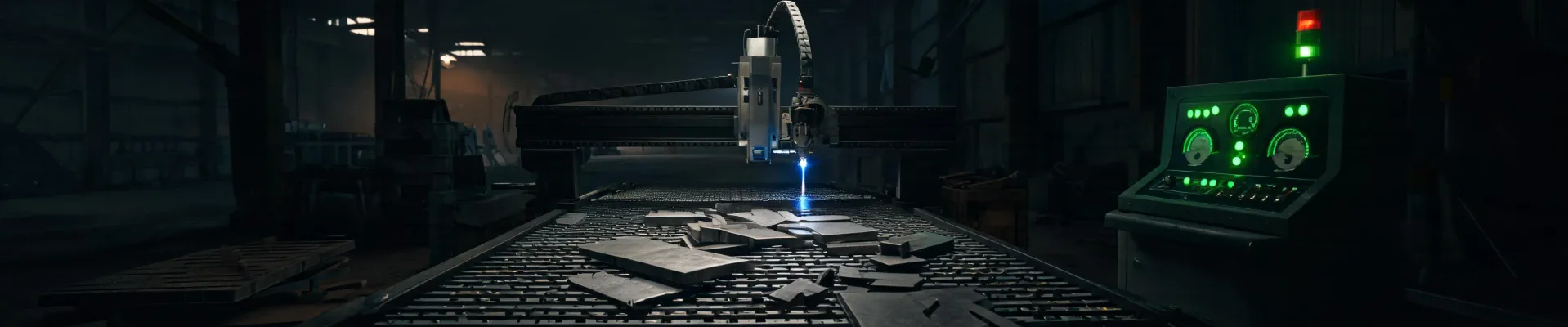
That's when I grabbed the Hypertherm Powermax85 Sync hand cutting system. It isn't a CNC table, and I won't pretend it is. But it cuts clean, the consumables are consistent, and it doesn't slow you down when every minute matters. We measured the damaged bracket, transferred the dimensions to a fresh piece of stainless, and cut the profile in one pass. Edge quality looked like a machine made it. Exactly what we needed.
Our shop handles Hypertherm machinery repair Texas every week, so I know what happens when plasma systems don't get maintained. This was a different job. The plasma cutter wasn't the thing being repaired; it was the thing doing the repair.
The Twist: The Old Bracket Was Lying to Us
Here's where the job nearly went sideways. We used the old bracket as a template for the new one. That felt obvious at the time. But when we went to fit the new piece, the hole pattern didn't line up. The old bracket had been heat-warped. What looked like a straightforward replacement was actually a misshapen piece of metal that had been doing its job for years while slightly twisted. Side by side, you could see it. Seeing that warp made me realize why measuring a failed part twice is just as important as cutting it correctly.
We clamped the new bracket in place, re-squared it from the conveyor rail, and recut the profile. Added forty-five minutes to the job. Not ideal, but workable.
Renting Welding Machine When the Deadline Is on Fire
Then we hit the real wall. Our shop TIG welder was already on another job in San Antonio. The diesel engine drive was in for service. We had a freshly cut bracket, a solid fit-up, and no way to weld it. The customer looked at me like I'd forgotten my toolbox at home. Maybe it sounds strange to be renting welding machine in the middle of an emergency repair. It isn't. Renting the right machine beats saying yes with the wrong one every time.
The rental unit showed up clean and ready. The torch was not. The gas lens didn't seat right, and the torch cup was the wrong size for the tungsten we needed. We had a tig welder cup with the correct fit in our own kit, swapped it in, and the weld pool finally stabilized. A tiny part. A huge difference. The rental shop swore the torch was ready. (It wasn't.)
Lesson one: when you're renting welding machine for a critical job, bring your own consumables. The power source is just a box of electronics. The torch, the cup, the gas lens, and spare tungsten are where reliability actually lives.
Why We Said No to a Pulse Laser Welding Machine
After the bracket passed a dye penetrant test, the plant manager asked why we didn't use a pulse laser welding machine instead. Fair question. Laser welding keeps getting more accessible, and for some repairs it's the ideal answer. A pulse laser welding machine is brilliant on thin stainless, precision mold work, and cosmetic welds where heat input has to stay low. A 12-inch structural bracket that will carry vibration and heat cycles is not that job. What sounds more advanced isn't automatically better for the part in front of you.
We don't own a pulse laser welding machine. I told the plant manager that directly. It's not a confession of weakness; it's the part of expertise people forget. The right tool for a thick stainless bracket with real load is a process with enough filler metal and enough heat control. A pulse laser would have burned too much time and too much money. The 'one machine to do everything' approach ignores the fact that every process has its own learning curve, consumables, and limits.
Professional Boundaries Are Worth More Than 'We Can Do It All'
Everything I'd read about emergency repairs says the person with the most impressive equipment wins. In practice, I've learned the opposite. The crew that understands its limits is the one that delivers. The repair shop that says 'this isn't our specialty, here is someone who does it better' earns trust for every job they do accept. That is the boundary I work from. It's also why our Hypertherm machinery repair Texas work stays sharp. We don't dilute the focus by pretending we can do everything in one shop.
Last quarter alone, we processed 47 rush orders with a 95% on-time rate. This one came close to breaking that streak. What saved it wasn't a bigger plasma cutter or a more exotic welder. It was knowing which tool to use, which tool to rent, and which tool to say no to. We delivered with 36 hours to spare. The plant line restarted on schedule. The bracket is still holding.
If you take one thing from this story, take the boundary part. Buy or rent the equipment that fits the job. Carry your own TIG consumables. And ask your service provider what they won't do. That answer tells you more than a list of machines.

Elise Marceau
Elise Marceau is an LED display and digital-signage systems analyst covering LED video walls, modular screens, transparent LED, control processors, and indoor or outdoor signage. She applies IEC 62368-1 safety principles while comparing pixel pitch, luminance, contrast, refresh rate, colour uniformity, viewing angle, ingress protection, power density, module serviceability, and signal redundancy. Her specification guides help integrators, venue operators, retailers, and procurement teams align viewing distance, ambient light, content format, installation access, electrical load, and lifecycle support.