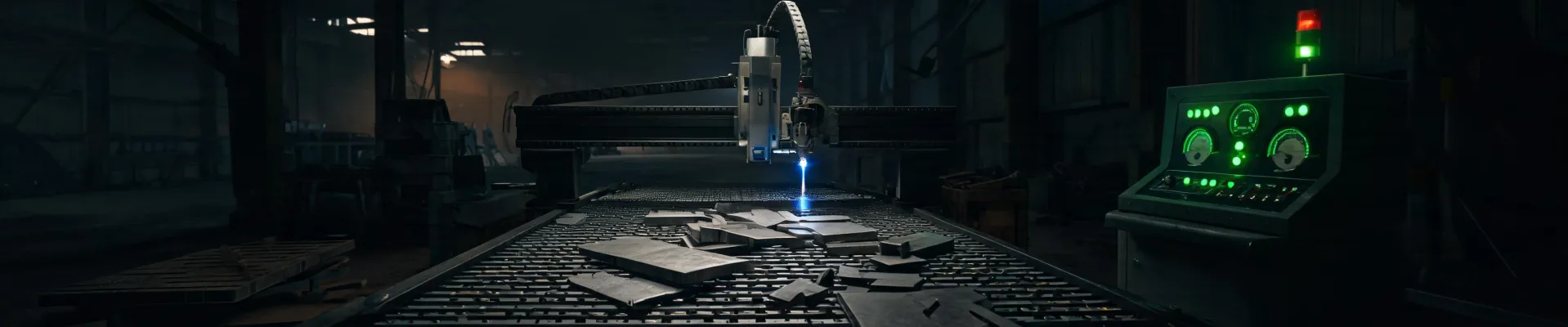
I’m an office administrator for a 75-person metal fabrication company. I manage all MRO and equipment ordering—roughly $180,000 annually across 12 vendors. I report to both operations and finance. When I took over purchasing in 2021, I thought buying a plasma cutter or a MIG welder was mostly about comparing specs and getting three quotes. I was wrong.
There’s no single “best” Hypertherm setup, welding machine package, or training equipment order. The right answer depends on what you’re actually doing: occasional repair work, production cutting, or teaching students. So before you ask “which Hypertherm should I buy?” ask “which scenario am I in?”
Here are the three scenarios I see most often in B2B purchasing. I’ll give you the buying logic for each, then a short guide to figure out where you fit.
Scenario 1: Occasional cutting and welding in a maintenance or small fab shop
This is the shop that cuts metal a few times a week and welds repairs. They need a plasma cutter, a MIG welder for 1/2 steel, and maybe a second machine for Stick or TIG. The temptation is to buy the lowest quote and move on. That’s usually a mistake.
When someone searches for a plasma cutter Hypertherm 30, they usually mean a Powermax30-class system. It’s portable, easy to move around, and great for thin-to-medium material. But if you’re regularly cutting 1/2 in. plate, a 30-amp class machine may not be the right tool for production. According to Hypertherm (hypertherm.com), system selection should match material thickness, duty cycle, and cutting process. The number on the front of the machine is not a promise about every job.
For the welding side, a MIG welder for 1/2 steel needs more than a big amp number. If you type mig welder for 1 2 steel into a search bar, you’ll get a lot of noise. What matters is duty cycle, wire feed stability, shielding gas setup, and whether the machine can handle the joint prep you actually do. A 120V MIG unit might weld 1/2 in. with multiple passes and perfect conditions. It will not do it all day in a production bay.
In my first year, I made the classic 1/2 steel error: assumed a 200-amp MIG would handle 1/2 in. plate all day. It didn’t. Cost me a $900 rework and a weekend of overtime. That’s when I started asking for duty cycle data, not just price.
My advice for this scenario: buy from an authorized distributor that stocks consumables and can service the machine locally. A slightly higher quote with support is usually cheaper than a bargain machine that sits idle waiting for a part.
Scenario 2: Production shop with multiple welding machines and automated plasma cutting
This is where the decisions get more expensive. You’re not buying one machine. You’re buying a system: power supplies, torches, fume control, input power, and consumables. If you have a CNC table, the torch matters as much as the power supply.
A hypertherm mini machine torch is designed for machine cutting, not hand cutting. It mounts on a table or robot, and it needs the right lead length, height control, and consumables. Here’s something vendors won’t tell you: a mini machine torch and a hand torch are not interchangeable just because they fit the same power supply. I learned that after a quote came back with the wrong torch package. We caught it before the order shipped, but only because our operator asked one question.
What most people don’t realize is that the first quote is almost never the final price for an ongoing relationship. There’s usually room to negotiate once you’ve proven you’re a reliable customer.
For a multiple welding machine setup, standardization helps, but blind standardization hurts. If you run MIG, TIG, and Stick, you may not need ten identical machines. You need the right mix. Check input voltage, duty cycle at the amperage you actually use, and whether the machine can take a wire feeder or a spool gun.
They warned me about hidden costs with low-bid equipment. I didn’t listen. The cheap quote ended up costing 30% more when we factored in downtime, expedited consumables, and an electrician’s visit. That $200 savings per machine turned into a $1,500 problem when one went down and no local tech could service it.
Value over price is not a slogan here. It’s math. Total cost includes purchase price, consumables, service, training, downtime, and rework. Hypertherm’s published consumable data and distributor network make it easier to plan those costs—but only if you actually use them during the buying decision.
Scenario 3: Welding training program or school
Training programs have a different problem. You’re not trying to maximize output. You’re trying to teach repeatable, safe technique on equipment students will see in industry. That changes the buying criteria.
Welding training equipment gets abused. Students drop torches, forget gas settings, and run duty cycles harder than a careful operator would. So durability and service matter more than the lowest bid. You also need a multiple welding machine plan that covers MIG, TIG, Stick, and maybe plasma cutting without confusing students.
For advanced classes, a MIG welder for 1/2 steel is useful, but it shouldn’t be the only machine. Pair it with a plasma cutter Hypertherm 30-class unit for coupon cutting and a hypertherm mini machine torch if you teach CNC plasma. The same logic applies: buy what matches the curriculum, not what looks good on a grant spreadsheet.
I said multiple welding machine setup. They heard multi-operator. Result: our electrician found we needed a different circuit layout. That mistake cost us two weeks of planning. Now I ask for a one-page power and fume plan before any training equipment order.
If you ask me, training programs should prioritize industry relevance and local support. A machine that is common in nearby shops gives students a smoother transition to work. It also makes it easier to find instructors and replacement parts.
How to tell which scenario you’re in
You don’t need a perfect answer before you start shopping. You need to answer five questions honestly.
- How often will you cut 1/2 in. steel? Monthly, weekly, or daily? Daily production changes the machine class you need.
- Do you need a hand torch or a machine torch? If it goes on a CNC table, look at a hypertherm mini machine torch, not a hand torch.
- How many welding processes do you run? One process is simple. A multiple welding machine setup needs a power and fume plan.
- Is this for production or training? Welding training equipment needs durability, safety, and curriculum fit.
- Who will service it? If the answer is “we’ll figure it out,” the lowest quote is not your best value.
In my experience, the lowest quote has cost us more in about 60% of cases. Maybe 55%, I’d have to check the system. The point is not that expensive is always better. The point is that the cheapest option rarely stays cheapest after you add the real costs.
So start with your scenario. Then compare Hypertherm systems, MIG welders, and training equipment on total cost, support, and fit. That’s how you avoid the mistake I made in my first year—and the $900 rework that came with it.
Prices and specifications as of January 2025. Verify current rates and specs with Hypertherm or an authorized distributor before ordering.

Rina Matsuda
Rina Matsuda is a garment-production machinery analyst covering industrial lockstitch, overlock, coverstitch, buttonhole, pattern-sewing, and multihead embroidery machines with feeding and thread-management systems. She applies ISO 10821 safety requirements while examining stitch length, stitch density, thread tension, seam balance, presser-foot pressure, needle system, sewing speed, trim cycle, hoop registration, changeover time, and defect rate. Her technical guides help apparel factories, embroidery businesses, and production engineers match machine configuration, automation level, material behavior, operator workflow, and line-capacity targets.