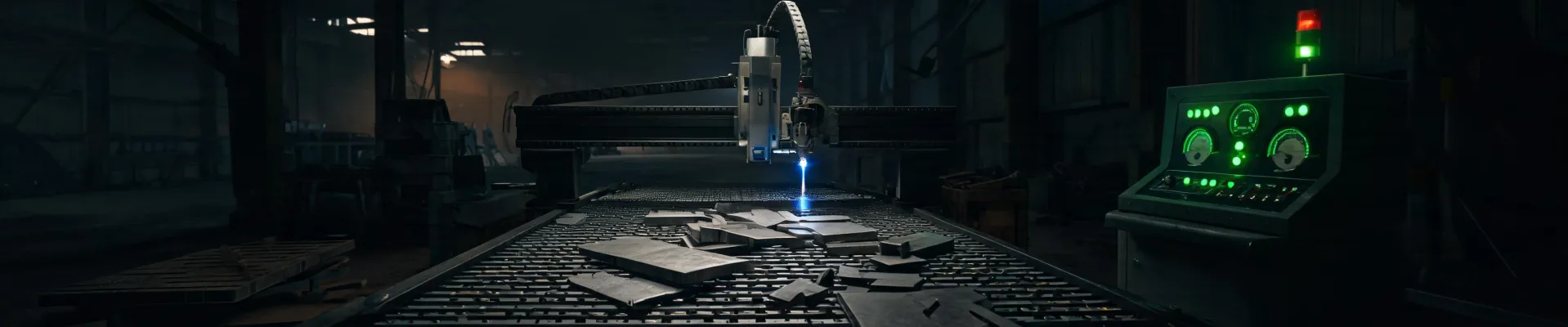
January 2023. The biggest contract we'd ever landed.
We signed a deal to produce 380 custom mounting brackets for a local HVAC manufacturer. $46,000 total. Estimated profit: about $12,000.
Three weeks later, profit on that job was $3,600.
Not because of labor. Not because of timelines. Not because of steel prices. Because of a plasma cutter I bought to save $900.
Backing up
We're a six-person fabrication shop. Structural steel, brackets, custom parts — not pretty work, but most of our clients couldn't tell the difference. Or so we assumed.
In August 2022, our old Hypertherm Powermax 900 finally gave out. The repair quote was $600, and the tech told me the board was about to fail anyway. Time for a new machine.
So I did my research. The shortlist:
Hypertherm Powermax30 XP plasma system (part number 088079). Two imported alternatives I found online with "comparable specs." And a walkthrough of a Linde welding gas & equipment center to see what actual machines looked like in person.
The Hypertherm was around $2,400. The import was $1,480. Same 30mm rated cut, same 220V input, same ~40 lb weight. I even checked Hypertherm Powermax 1650 price points — roughly $4,200–4,800 as of fall 2022, depending on configuration — before deciding that tier was beyond our budget.
A welder friend of mine, foreman at a larger shop across town, told me: "Buy the $1,480 torch and you're gambling on a repair."
I figured that was brand loyalty talking. He ran a name-brand setup.
I stopped by the Linde welding gas & equipment center to look at machines up close. I took a few photos of the display — the clean feed tracks, the operator running a demo cut on a test plate in under a minute, the kind of cut face that doesn't need touching afterward. I stood there for maybe ten minutes.
Then I bought the cheaper one anyway.
Hit "confirm" and immediately thought, "What if I'm wrong about this?" Didn't relax until the machine shipped two days later and I told myself the reviews were good enough.
Four months of "good enough"
The budget machine worked. Sort of. Thin-gauge jobs — brackets from 14-gauge sheet — it handled fine. Cut edges were rougher than our old Powermax, but nothing a quick pass with a grinder couldn't fix. Nobody complained.
Then came January.
First 40 brackets were fine. Around number 41, our operator started noticing inconsistent cuts on thicker plate. Half-inch material — the kerf would widen mid-cut. Dross buildup was double what we budgeted for. What used to take two minutes of cleanup per bracket was now taking fifteen.
I called the vendor. Their tech support told me to adjust the air pressure.
I set it to 80 psi. They said 65. I set it to 80. Wait — that's what I'd already done. The back-and-forth ate a full afternoon. In three weeks I talked to four different reps. Not one of them could tell me how to properly recalibrate the torch height sensor. One advised me to "just cut faster and ignore the dross."
By week three, we were six days behind. The client threatened to cancel.
We emergency-bought a Hypertherm Powermax30 XP — $2,490, local distributor, next-day delivery. The moment we fired it up, cut quality was consistent. No tweaking. No guessing. We just cut and moved on.
And then the welder
While we were scrambling to catch up, the second problem surfaced.
Our flux-cored MIG welder — another budget purchase — started producing erratic welds on some bracket touch-ups. Spatter everywhere, inconsistent penetration. Our welder adjusted the settings three times and shook his head.
He pulled our old Lincoln out of storage. Fired it up. Clean welds, every time.
That flux-cored machine is now listed on a used equipment marketplace. I should add that we'd been running it for less than a year.
The math
When the dust settled on that project, I tallied everything:
- Emergency equipment replacement: $2,490
- Labor to re-cut 127 brackets: 34 hours @ $65/hr = $2,210
- Expedited shipping + overtime: $1,400
- Client penalty for missed deadline: $1,200
- Grinding consumables on the bad batch: ~$400
- Steel wasted on re-cuts: ~$1,100
- Company-funded overtime dinners (seriously): ~$180
Total: about $8,980.
What we saved on the machine: $920.
Put another way: we spent $8,980 to save $920. A 4x loss.
And that's not counting the client conversation. They didn't cancel — but they also didn't send us another job for ten months. Not until we'd switched to proper equipment and eaten the cost of a free sample run to win back their confidence.
The checklist now
Every shop welding machine we bring in now goes through a three-question pre-check. Three, in this order:
- Can it cut the plate you actually cut — not the rated thickness, the real plate? Test it on scrap before you commit.
- If it goes down, can someone local fix it the same day? Not "ship it back." Same day.
- Is there a shop running this machine on the exact kind of work you do?
If any answer is "probably" — we don't buy it.
What I keep coming back to
Look, I'm not saying budget equipment is always a mistake. I'm saying it's a gamble you don't always know you're taking.
The $1,480 machine worked long enough to feel like a win. Then it failed at the wrong time, on the wrong job, and cost us four times what we "saved."
Quality isn't just about the output. It's about what the output says about you. That HVAC client didn't stop calling because our bracket was late. They stopped calling because they weren't sure what they'd get next time.
The fix wasn't the $2,490 plasma cutter. The fix was realizing that the $900 I thought I was saving was actually a $900 bet against my own shop's reputation.
I lost that bet. Won't make it again.

Gabriel Moretti
Gabriel Moretti is a laser-processing equipment analyst specializing in fibre and CO2 laser cutting, marking, engraving, and welding machines for sheet metal, tubes, polymers, wood, and coated components. He applies ISO 11553-1 laser-safety requirements while comparing wavelength, rated power, beam quality, spot size, focal tolerance, cutting speed, kerf width, heat-affected zone, assist-gas demand, enclosure design, and extraction capacity. His engineering guides help fabricators and equipment buyers align source type, material response, process window, automation, guarding, and throughput expectations.