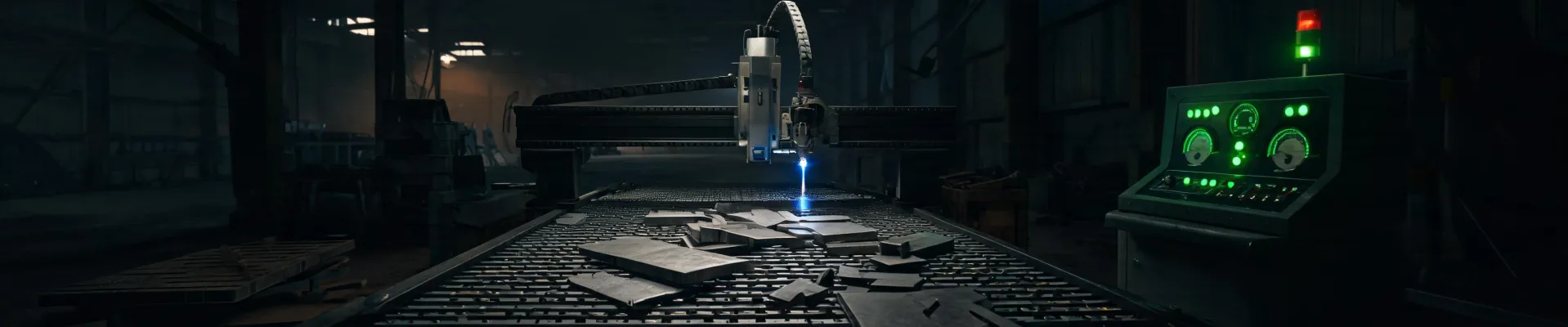
"It's Just a Torch Head. How Different Can It Be?"
I'm a procurement and maintenance manager handling welding and cutting equipment orders for 8 years. I've personally made (and documented) 11 significant mistakes, totaling roughly $47,000 in wasted budget. This is the one that changed how I buy everything.
In my first year, I assumed a plasma cutter torch head assembly was just... metal parts. Same thread. Same dimensions. The OEM part was $285. The aftermarket "equivalent" was $89. I saved $196 per unit across 12 machines and felt like a genius.
That feeling lasted about four months.
Eight of those twelve torch heads failed. Not catastrophically—no injuries, no fires. Just degrading performance. Inconsistent cut quality. Excessive dross that our QC team kept rejecting. And a growing pile of customer complaints traced back to cuts made with those "identical" heads.
The worst part? I knew I should've checked the consumable compatibility matrix. But I thought, "what are the odds the tolerances are actually different?" Well, the odds caught up with me when we calculated the total damage: $3,200 in rework, expedited replacement parts, and one very uncomfortable meeting with our operations director.
What's Actually Happening Inside a Torch Head
Here's what I didn't understand back then: a torch head assembly isn't a standalone part. It's one component in a precisely engineered system.
Hypertherm designs their consumables—electrode, nozzle, swirl ring, shield—as an integrated set. The gas flow dynamics, the cooling pathways, the electrical conductivity: all calibrated together. When you swap in a third-party torch head that looks the same but has different internal geometry, you're not saving money. You're introducing a variable the system wasn't designed for.
The failure mode isn't immediate. That's what makes it so dangerous.
First, you notice slightly shorter consumable life. A nozzle that used to last 800 starts lasting 600. Annoying, but manageable. Then the cut quality drifts. Operators compensate by slowing down or increasing amperage. That accelerates wear on the electrode. The swirl ring gets contaminated faster. Suddenly you're replacing consumables every two weeks instead of every six.
"The surprise wasn't the torch head failure itself. It was how one 'cheap' part triggered a cascade of costs across the entire operation."
And here's the part nobody warns you about: when a customer rejects a batch because the edge quality is out of spec, they don't care that you saved $196 on a torch head. They care that their delivery is late.
The Cost Chain Reaction
Let's talk about what those "saved" dollars actually cost.
Direct replacement costs: $3,200 in the first year alone. That's OEM torch heads we had to buy anyway, plus expedited shipping because machines were down.
Consumable waste: We burned through roughly 40% more electrodes and nozzles during the period those aftermarket heads were in service. At $18-$45 per consumable across 12 machines, that adds up fast.
Labor and downtime: Every torch head swap takes 20 minutes. But diagnosing why cut quality degraded? That's hours. Multiply by 8 machines and you're looking at nearly a full week of lost production time.
Reputation cost: One customer sent back an entire order. They didn't say it was our fault—they just quietly moved their next project to a different supplier. That's the kind of cost you can't put on a spreadsheet.
After the third rejection in Q1 of that year, I created our pre-purchase checklist. We've caught 47 potential compatibility issues using it in the past 18 months. That checklist has saved us more money than any bulk discount ever did.
This Isn't Just About Plasma Cutters
I see the same pattern across every piece of industrial equipment we buy.
Take TIG welders. Can a TIG welder weld aluminum? Yes—but not every TIG welder. You need AC capability or advanced waveform control. You need the right tungsten electrode. You need a high-frequency start. Someone looks at the price tag, buys a $600 DC-only machine, then discovers it won't do the job. Now they're buying a second welder.
Same story with laser welders. Photonics laser welders have specific requirements for joint preparation, shielding gas, and material thickness. The "budget" option that claims to handle everything usually handles nothing particularly well. And exothermic welding machines? The kits are cheap. The molds, the cartridges, the training—that's where the real cost lives.
The pattern is always the same: the purchase price is just the entry fee.
How I Calculate TCO Now (And You Should Too)
Before I approve any equipment purchase, I run it through a simple framework. It's not perfect, but it's caught enough bad decisions that I trust it.
- Acquisition cost: The quote. This is what everyone looks at. It's maybe 30% of the real number.
- Consumable lifecycle cost: For plasma cutting systems, this means electrodes, nozzles, shields, swirl rings. For welding, it's wire, gas, tips, liners. Calculate cost per cut or cost per inch of weld—not cost per part.
- Compatibility risk: Will this part or machine actually work with our existing setup? Or will we need adapters, upgrades, or replacements?
- Downtime exposure: If this fails, how long until we're running again? What's the cost per hour of that downtime?
- Support and documentation: Does the manufacturer publish consumable life data? Do they have a compatibility matrix? Can I get a straight answer about what won't work?
Here's the thing: most of those hidden fees and compatibility headaches are avoidable if you ask the right questions upfront. The $500 quote that looks cheap becomes $800 after shipping, setup, and the first round of "surprise" consumables. The $650 quote that's all-inclusive was actually cheaper.
That $3,200 mistake taught me more than any training course. Now when someone sends me a quote, I don't ask "how much?" I ask "what's everything I'll need to make this work—and what happens when it doesn't?"
The torch head didn't fail because it was cheap. It failed because I treated it as an isolated part instead of a system component. The real cost of any equipment isn't the invoice—it's everything that happens after it.

Elise Marceau
Elise Marceau is an LED display and digital-signage systems analyst covering LED video walls, modular screens, transparent LED, control processors, and indoor or outdoor signage. She applies IEC 62368-1 safety principles while comparing pixel pitch, luminance, contrast, refresh rate, colour uniformity, viewing angle, ingress protection, power density, module serviceability, and signal redundancy. Her specification guides help integrators, venue operators, retailers, and procurement teams align viewing distance, ambient light, content format, installation access, electrical load, and lifecycle support.