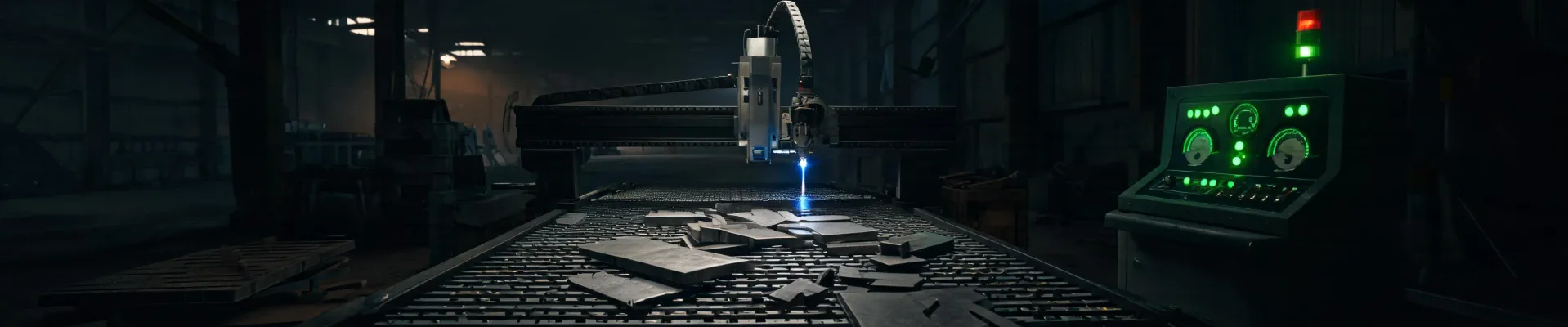
When I first started managing equipment purchases, I assumed renting was the lean move. No capital. No maintenance. No depreciation. Then a railway bracket order in March 2024 turned that assumption into a line item I won't forget.
The Rental Quote That Made Perfect Sense
In March 2024, our Hypertherm 190c plasma cutter tripped a breaker in the middle of a run. We had a rail bracket order due in eleven days. The plant manager walked over with the obvious answer: just rent a welder and a plasma cutter for the week. I pulled quotes before I argued with him.
One supplier quoted $118/day. Another was $150/day with free delivery. A third said "about $200 depending on availability." The fourth never got back. Based on the lowest quote, a two-week rental would cost $1,300. A new Hypertherm Powermax45 SYNC plasma cutter was roughly three times that amount. Renting looked obvious.
I was wrong.
Why "Per Day" Is the Wrong Unit of Measurement
Rental costs are not the daily rate. They are the daily rate plus delivery fee, pickup fee, late-return fee, gas bottle swap, missing consumables, and the hour an operator spends fixing someone else's torch. I know this because I tracked every equipment invoice for six years. In 2023, we spent just over $21,000 on "small" rental extras. That money never appeared in the original quote.
The question everyone asks is, "What's your best daily rate?" The question they should ask is, "What happens if it isn't here?"
I used to think rush fees were just suppliers gouging customers. Then I saw the operational reality: a truck that leaves the shop at 6am, a scheduler moving three other orders, a mechanic pulled off another job. The fee buys a promise. To be fair, rental companies have a hard job. They can't hold a machine for you forever. But that's exactly why the rental model struggles when the deadline is not flexible.
In Q2 2024, we compared eight suppliers over three months using our TCO spreadsheet. The lowest quote came in 38% below the average. It also had the least specific delivery language. We didn't choose it. That decision saved us from a predictable redo.
What a Missed Railway Possession Actually Costs
On rail work, the machine is never the true cost. The possession window is.
If you haven't worked near tracks, a possession window is when the line is closed to traffic and your crew is allowed on the ballast. For a rail repair, you might get two hours. The crew, the railway welding machine, the fit-up, the preheater, the cooling timetable—all of it has to line up inside that window.
A railway welding machine isn't a special category in the rental catalog. It's a welder that has to show up on the same day you do.
In May 2024, one such welder didn't show up. A supplier delivered the wrong machine; the power connection didn't match the site generator. The job was rescheduled for the next possession window, six days later. The penalty and labor reset cost us just under $4,800. The weekly rental rate had been $640.
That is the time certainty premium. It isn't a fee for speed. It's a fee to avoid a single point of failure on a schedule you don't control. In an emergency, "probably on time" is the most expensive phrase in the English language. After getting burned twice by "probably on time" promises, we now budget for guaranteed delivery.
Own the Critical Piece, Rent the Redundancy
So here is where I landed. As of February 2025, our primary cutting unit is a Hypertherm Powermax45 SYNC plasma cutter. I fought the purchase. It wasn't in the budget. But it solved the exact risk that rental couldn't solve.
According to Hypertherm's product documentation (hypertherm.com, accessed February 2025), the Powermax45 SYNC is a 45-amp portable plasma system with a single-piece SYNC cartridge that combines electrode, nozzle, and swirl ring. That matters in a shop because a consumable change takes minutes and doesn't require torch setup guesswork. The old Hypertherm 190c plasma cutter became our backup. It isn't the primary machine anymore, but on the day a rental supplier called to reschedule, it was the machine that kept us from calling the customer to ask for more time.
If you search "renting welding machine" from our shop, you'll get daily rates. Fine. But daily rates don't show up on the rail at 6am. I'm still not against rental equipment; I'm just in favor of renting the right things. We rent a diesel-powered welder twice a year for field work. Now the rental contract includes a delivery window with a real penalty. If the machine isn't there by an agreed hour, the vendor pays for the second truck.
If You Search "How to Set Up a MIG Welder Without Gas"
One search that keeps showing up in our referral logs is "how to set up a mig welder without gas." The short answer: use flux-cored wire, not solid wire. Remove the gas line, check the wire manufacturer's polarity chart—most self-shielded flux-cored wires run DC electrode negative—and use a knurled drive roll if the wire is soft. It works for tacks and temporary repairs.
It is not a substitute for an approved welding procedure on a load-bearing rail joint. For that, verify the process against the rail owner's specification. The American Railway Engineering and Maintenance-of-Way Association (AREMA) publishes recommended practices for track work, and many owners have their own procedure requirements. Verify before you weld.
The Premium Is Worth It
Here is the shift in how I buy equipment. I don't buy machines. I buy options. A machine I own is an option I can exercise at 2am. A rental contract is an option someone else can cancel.
The Hypertherm Powermax45 SYNC plasma cutter wasn't the cheapest choice in my spreadsheet. It was the only one that guaranteed we would cut steel on the day we promised. When the deadline is fixed and the penalty is real, that guarantee is worth the premium. I've kept every receipt to prove it.

Elise Marceau
Elise Marceau is an LED display and digital-signage systems analyst covering LED video walls, modular screens, transparent LED, control processors, and indoor or outdoor signage. She applies IEC 62368-1 safety principles while comparing pixel pitch, luminance, contrast, refresh rate, colour uniformity, viewing angle, ingress protection, power density, module serviceability, and signal redundancy. Her specification guides help integrators, venue operators, retailers, and procurement teams align viewing distance, ambient light, content format, installation access, electrical load, and lifecycle support.