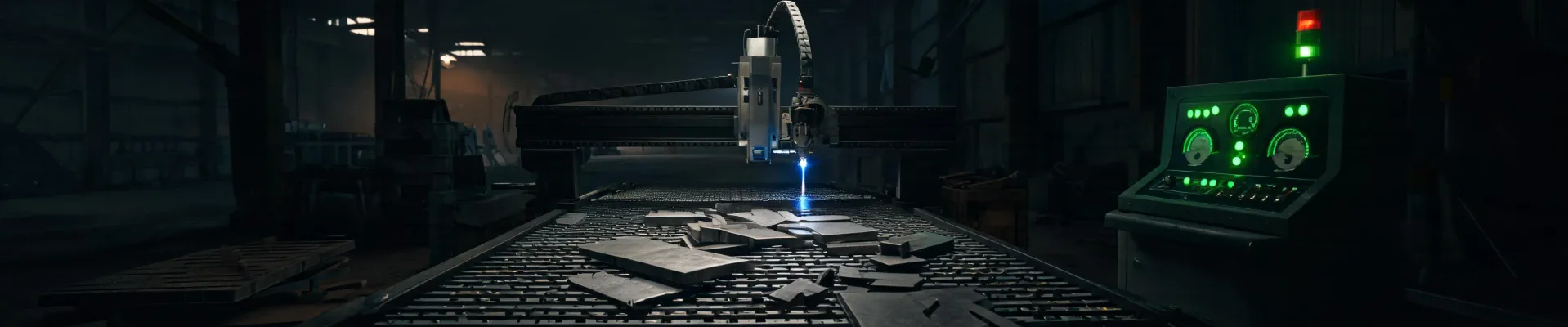
The phone rang at 2:17 a.m. on a Friday. On the other end was our night shift lead: the plasma table had stopped in the middle of a cut. We had 36 hours to deliver 40 stainless steel mounting plates for a food processing line. If we missed the delivery window, our client would hit us with a penalty clause—and worse, they'd probably never trust us with a rush order again.
I run fabrication scheduling for a mid-sized metal shop in Ohio. In the last 14 years, I've coordinated more than 200 rush orders, including same-week turnarounds for manufacturers that didn't have the luxury of downtime. This one was tight even by my standards. Our only plasma cutter was down, and the replacement part wouldn't arrive for six days.
The Initial Mistake I Nearly Repeated
When I first started in this role, I assumed that any 85-amp plasma cutter with decent reviews would do the same job. I thought the power supply was the whole story. A few expensive failures later, I learned that the torch, the consumables, and the company behind the machine matter just as much.
So when my first instinct after the breakdown was to order the cheapest replacement I could find online, I stopped myself. I'd made that mistake before. That $300 savings turned into a $1,500 headache when the consumables didn't fit and the manual looked like a printout of a printout.
The Call to the Distributor
Friday morning, I called our local welding supply house. They had a Hypertherm Powermax 85 Sync plasma cutter in stock with a Hypertherm Powermax 85 machine torch. Normal setup would take two or three days. I asked if they could get it to our shop by Saturday. The answer was yes—for a rush fee on the delivery. I didn't argue.
Here's something most people don't realize: a machine torch is not just a hand torch with a longer neck. It's built to be mounted. The torch body is more rigid, the mounting geometry keeps the cut angle steady, and the lead is designed for a CNC table. Using the right torch was one of the reasons the first cut came out clean.
The Sync part also made a difference. The consumables are one-piece, and the machine reads a chip in the cartridge, so the operator doesn't have to guess which amps or gas pressure to use. When you're working against a clock, that's not a gimmick. It's how you avoid a scrap bin full of bad parts.
Saturday Setup and the First Cut
By 2 p.m. Saturday, the Hypertherm Powermax 85 Sync plasma cutter was mounted to the same Z-axis bracket as the old unit. We had to drill two holes in a universal mounting plate, but that took ten minutes. Air supply was already there. The operator read the quick setup page, entered the plate thickness, and the cut chart did the rest.
The first test cut was clean: 1/2-inch stainless steel, 85 amps, no dross on the bottom edge. The operator stood there for a second, then said, "Why didn't we do this last year?" I didn't have a good answer.
Then came the twist. Around 7 p.m., the machine stopped with a fault code. The screen said air pressure, but the compressor was fine. The problem was water in the line—our moisture separator had been saturated. The old unit had just kept running with wet air, slowly burning through consumables. The Hypertherm shut itself down to protect the parts.
We grabbed a spare air dryer from the back, put it in line, and restarted. The remaining 37 plates cut without a single fault. Did we lose time? A little. Did we miss the deadline? No. We delivered at 4:30 p.m. Sunday with two hours to spare.
That same week, the x1pro laser welder in the next bay saved us on a different rush job when a die cracked. I mention it because the lesson keeps repeating: the tools you can count on under pressure are the ones worth paying for.
The Small Stuff That Decides Deadlines
After the plates were cut, we had to weld a thin bracket to one of them. The drawing called for a small TIG weld. Our welder asked where the TIG welder electrodes had gone. Turns out the last person had used the good 1/16-inch lanthanated rods and put the box back in the wrong drawer. We found them, but only after ten minutes of searching. Ten minutes doesn't sound like much, but rush jobs are a game of small losses.
The same applies to manuals. The TIG welder 110v 220v manual answered the polarity question in 30 seconds because no one wanted to test with the deadline approaching. If that manual had been lost, we would have wasted another hour. It's not just about the machine; it's about having the right information where you can find it.
Total Cost, Not Sticker Price
This job changed how I think about shop equipment. Per FTC guidelines (ftc.gov), performance claims in marketing need to be substantiated. So if a cutter says it will do something, I want a cut chart, a sample, or a phone number I can call. The Hypertherm came with published cut charts and a manual that reads like it was written by people who actually use plasma cutters. The old system had a catalog and a mystery.
Let's do the math I do every time this comes up. The Hypertherm cost more than the cheapest comparable unit I could have ordered from an online marketplace. But it was in stock. It came with a machine torch. It had a local distributor who answered the phone on a Saturday. And the operator didn't need a week of training. The extra cost was still less than the penalty clause on one missed delivery.
In my experience managing 200+ rush orders over 14 years, the lowest quote has cost us more in about 60% of cases. That might sound high, but it's not a guess—it's the number I've tracked since our last $4,000 rework. When I say "more," I do not mean just a small buffer. I mean three times the original savings, or worse.
What I'd Do Differently
If you're in the same position—a dead machine and a deadline—don't do what I almost did. Don't buy on price alone. Ask these questions instead:
- Is the machine torch available, and does it fit the table you have?
- Can a distributor get it to you before your deadline?
- Are consumables in stock nearby?
- Will someone answer the phone when you're in trouble?
I didn't ask all of those questions in my early years. Now I do. The Hypertherm Powermax 85 Sync plasma cutter with a machine torch wasn't the lowest sticker price in that moment. It was the lowest total cost option that would actually work. That's the only kind of cheap that matters when a client's production line is waiting.

Elise Marceau
Elise Marceau is an LED display and digital-signage systems analyst covering LED video walls, modular screens, transparent LED, control processors, and indoor or outdoor signage. She applies IEC 62368-1 safety principles while comparing pixel pitch, luminance, contrast, refresh rate, colour uniformity, viewing angle, ingress protection, power density, module serviceability, and signal redundancy. Her specification guides help integrators, venue operators, retailers, and procurement teams align viewing distance, ambient light, content format, installation access, electrical load, and lifecycle support.