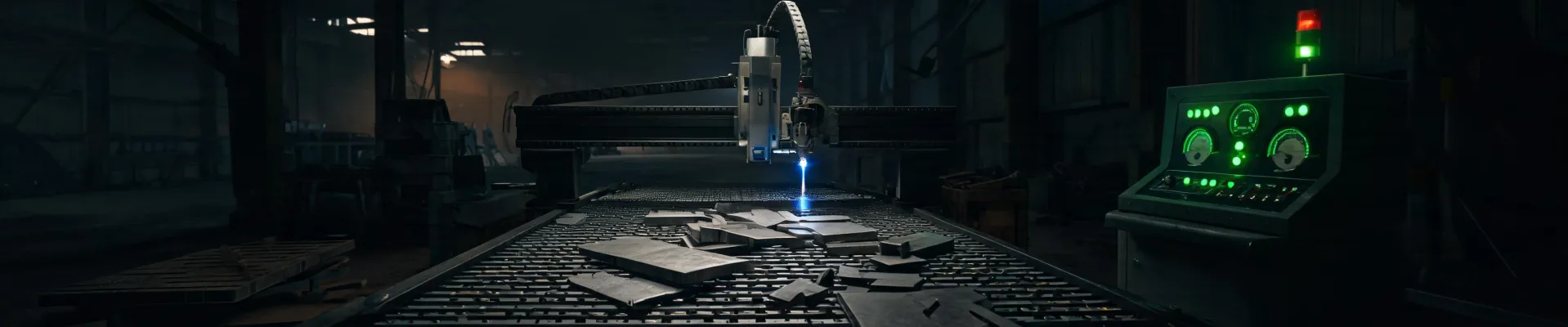
First, figure out which emergency you're actually in
I run production scheduling at a mid-size metal fabrication shop. When I get a call that something's gone wrong, the first thing I do isn't panic — it's triage. Because "we have a problem" means three completely different things depending on what actually broke.
Here's how I break it down:
- Scenario A: Your cutting equipment just died and you have a hard deadline (48 hours or less)
- Scenario B: Your MIG welder vacancy just went from "annoying" to "we can't ship"
- Scenario C: You need to upgrade capability before the next job comes in
Each one needs a different playbook. I've lived through all three in the past 18 months, and I've made expensive mistakes in two of them.
Scenario A: The plasma cutter died and the clock is ticking
In March 2024, our primary Hypertherm unit threw a fault code at 4:30 PM on a Thursday. We had a structural steel order due Monday morning. About $22,000 in revenue and a $3,500 late penalty riding on it.
Here's what I've learned the hard way: your first move isn't ordering a new machine. It's figuring out whether the problem is the power supply, the consumables, or the torch itself.
Nine times out of ten, it's the consumables — electrodes, nozzles, shields. If you don't stock spare hypertherm plasma cutter torch parts, that's the lesson you learn in the worst possible way. We burned six hours calling around before finding a local distributor with the right torch assembly in stock.
If the machine itself is down and you need to cut metal today, here's the honest ranking:
- Borrow or rent from another shop in your network. Fastest if you have relationships.
- Call your distributor and ask about a loaner. Some will do this for established accounts.
- Buy a replacement. This is the expensive panic move, but sometimes it's the only one.
If you're going the replacement route and want something that'll actually serve you long-term, the Hypertherm Powermax 85 Sync plasma cutter is what I'd look at for a shop doing 1-inch mild steel and thinner. It's not cheap. But I've watched a shop down the street cycle through three budget units in the time our Powermax has been running.
Honestly, I'm not sure why some shops treat consumables inventory as an afterthought. My best guess is that it feels like hoarding until the day it saves your entire week.
Scenario B: Your MIG welder vacancy just became a crisis
We lost two welders in six weeks last fall. One retired, one left for a competitor. Our MIG welder vacancy went from a manageable gap to a bottleneck that pushed three jobs past their promised ship dates.
I have mixed feelings about the whole hiring situation. On one hand, good welders are worth every dollar and then some. On the other hand, the market for skilled labor is genuinely broken right now, and no amount of competitive pay fixes a shortage of qualified people.
What actually worked, in order of effectiveness:
- Contract welders from a staffing agency. Expensive. But they show up and they can pass a test. Expect to pay 1.5–2x standard hourly.
- Overtime for existing staff. Burns people out fast. Works for 2–3 weeks, not 2–3 months.
- Re-evaluating what actually needs a certified welder. Some of our "welding" work is really just tacking and fitting. That's a different skill set and a different hire.
One thing I'd push back on: buying a x1pro laser welder as a response to a labor shortage. I've seen shops try this. The theory is that a laser welder is easier to operate and reduces the skill barrier. In practice, it's a different process with its own learning curve, and it changes your fixturing requirements. It's a capability upgrade, not a staffing solution. Don't let a vendor sell it to you as the latter.
Even after we filled both positions, I kept second-guessing our hiring pipeline. What if the next person leaves in three months? We ended up cross-training two of our press operators on basic MIG so we're never fully dependent on a single person again.
Scenario C: Preemptive upgrades (the scenario nobody thinks they're in)
This is the one I want more shops to recognize. If you're not currently in a crisis, you're in Scenario C — and it's the only scenario where you get to make calm, rational decisions.
Two capability gaps I see shops ignore until they become emergencies:
Field work. If you do any on-site repair or installation, a gasoline powered MIG welder changes what jobs you can bid on. It's not a daily-use machine, but when you need to weld 40 feet from the nearest outlet, you need it. The mistake I see is buying the cheapest one and discovering it can't hold a stable arc under load.
Thickness range. If you're turning down jobs because your current machine can't handle the material, that's lost revenue you're not tracking. I started logging every declined quote for a quarter. The total was uncomfortable.
Part of me wants to consolidate everything to one brand and one supplier for simplicity. Another part knows that redundancy is what saved us when our primary plasma supplier had a six-week backorder in 2023. We compromise with a primary + backup setup, even though it costs more in inventory.
How to tell which scenario you're in right now
Ask yourself three questions:
- Is there a customer waiting on delivery right now? If yes, you're in Scenario A or B. Go straight to the relevant section.
- Am I turning down work or paying overtime to cover a gap? If yes, you're in Scenario B. The gap is real, even if it hasn't blown up yet.
- Have I declined a quote in the last 90 days because of equipment limits? If yes, you're in Scenario C. Start planning your upgrade before it becomes an emergency.
The shops that survive are the ones that treat Scenario C seriously. The ones that cycle through Scenario A every few months are the ones that never learned to plan ahead. I know because we used to be the second kind.
"Based on our internal data from 27 rush equipment decisions over three years, the shops that planned in Scenario C spent roughly 40% less per capability upgrade than those forced to buy in Scenario A."
If you take one thing from this: the time to think about your next machine or your next hire is before you desperately need one. Everything else is just damage control.

Elise Marceau
Elise Marceau is an LED display and digital-signage systems analyst covering LED video walls, modular screens, transparent LED, control processors, and indoor or outdoor signage. She applies IEC 62368-1 safety principles while comparing pixel pitch, luminance, contrast, refresh rate, colour uniformity, viewing angle, ingress protection, power density, module serviceability, and signal redundancy. Her specification guides help integrators, venue operators, retailers, and procurement teams align viewing distance, ambient light, content format, installation access, electrical load, and lifecycle support.