The quote that looked like a bargain
I'm a procurement manager at a 230-person metal fabrication company. My job is to keep the cutting and welding budget from exploding—around $180,000 a year, give or take. For the past six years, I've tracked every invoice, every quote, and every service call in our cost system.
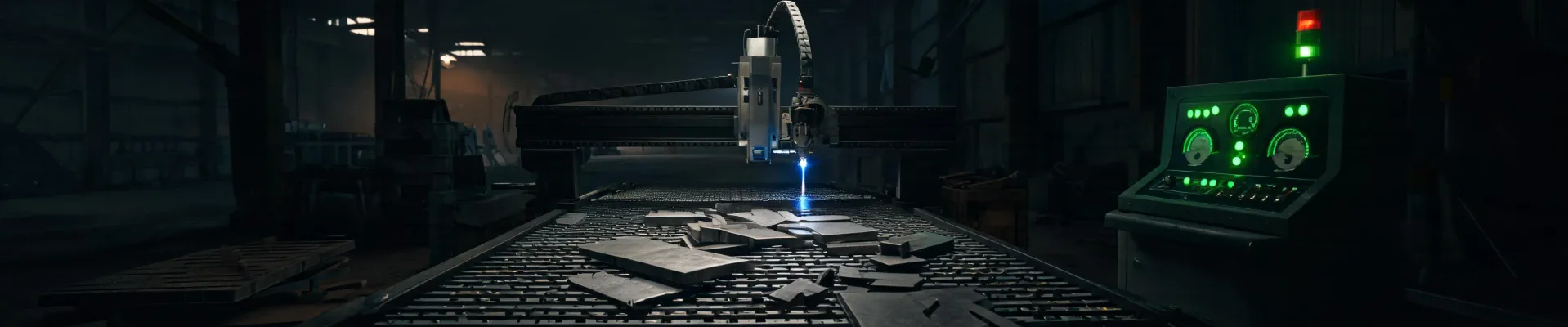
So when a quote for a Plasma cutter Hypertherm 85-class system came in $1,800 lower than the authorized dealer, I almost signed. Maybe it was $1,500. I'd have to check the spreadsheet. The supplier had a clean website, a long client list, and a factory that builds automated welding lines. They also build hairpin welding machines for electric motor manufacturers. A one-stop shop.
What could go wrong? Plenty.
The real problem is not the price
The problem isn't that the supplier was dishonest. I don't think they were. The problem is that I almost made a decision based on a simple mental shortcut: if a visual tracking welding equipment factory can build camera-guided seam tracking, they can certainly build or source a good plasma cutter.
That's the mistake I want to unpack. It's a mistake I've seen repeated in our industry.
Here's the thing: a visual tracking welding equipment factory usually earns its reputation through years of vision-guided welding process data. That's about motion control, cameras, arc sensors, and production software. A plasma cutter, on the other hand, is a high-frequency power supply combined with gas flow and consumable design. Both use an arc. The engineering is not the same.
What most people don't realize is that a one-stop supplier in industrial equipment often means several product teams under one roof, not one deeply integrated engineering team. The sales brochure is one-stop. The support, the spare parts, and the process knowledge are often not.
Look, I'm not saying every generalist is bad. I'm saying a specialist who knows their limits is usually safer than a generalist who says yes to everything.
Why 'convenience' gets expensive
Let's talk about total cost of ownership. When I compare quotes, I use a simple frame:
- Machine price, but also consumables, training, and installation.
- Downtime when something goes wrong, and how fast someone answers the phone.
- Rework from cut quality or weld quality that doesn't meet print.
- Safety: equipment that isn't supported or doesn't operate to spec.
The first quote is almost never the final price for ongoing relationships. There's usually room to negotiate once you prove you're a reliable customer. But here's something vendors won't tell you: the price you don't see is the one that comes later, in the form of consumables that burn up quickly or a support team that doesn't know the product.
In our case, the difference in quoted price was likely $1,800. But the real difference was service response. The authorized dealer had a cut chart for every material thickness and someone who could answer a question about consumable life in minutes. The one-stop factory's sales rep kept saying the machine was 'same same, just shorter lead time.' In my experience, 'same same' is project manager speak for 'we haven't tested this exact combination.'
This is not a knock on that factory. If I needed a hairpin welding machine, they would be on my short list. But a hairpin welding machine and a Plasma cutter Hypertherm 85 require different after-sales experience. One is a production system with vision tracking and weld data logging. The other is a cutting process with amperage, gas, and consumable variables. They share an arc, not much else.
The 'one vendor for everything simplifies maintenance' thinking comes from an era when equipment was simpler. Today, a modern automated welding line runs on software that requires regular updates and specialists who understand weld data. A plasma cutter has its own duty cycle, supply voltage, and air-quality requirements. The service skills don't fully overlap. That's changed, and a lot of procurement people haven't updated their mental model.
The cost I don't put on a spreadsheet
Now the part that's uncomfortable to talk about. I remember reading about a Minnesota welder killed in a shop accident. I don't know every detail, and I'm not going to pretend I do. But when I see news like that, my first thought isn't about the operator. It's about the purchasing trail. How did that machine get there? Did someone buy it because it was $1,800 cheaper? Did someone skip training because the vendor promised it was plug-and-play?
Equipment decisions ripple into the shop floor. If a machine is undersized, uncalibrated, or modified beyond spec, it can behave in ways an operator didn't expect. A plasma cutter that goes through consumables quickly doesn't just cost money. It can produce poor cuts, more grinding, more handling, and more chances for something to go wrong. I'd rather pay for support I never use than risk the one time I really need it.
What we do now
We've changed our buying process. For plasma cutting, we buy from category specialists like Hypertherm and from distributors that stock genuine parts. If someone asks me about a Hypertherm 600 plasma cutter on the used market, I tell them the same thing: understand what you're buying. I want to say the old Powermax600 was a 40-amp class unit, but don't quote me on that. Verify the machine's service history, test it, and ask for cut samples before you commit.
Based on Hypertherm's current product information (hypertherm.com, 2025; verify current specs), the Powermax85 is rated at 85 amps and designed for heavy-duty fabrication cutting. That spec sheet is part of why I went back to the authorized route. I wanted the process support that goes with the machine, not just the machine.
For automated welding, we go to a factory that does nothing else. If we're evaluating a visual tracking welding equipment factory, we ask to see actual seam tracking data, not a brochure. We ask which process they specialize in. And we take note when a vendor says 'this isn't our strength—here's who should build it.' That vendor just earned our trust for everything else.
If you ask me, that's what real expertise looks like. It's not having an answer for everything. It's knowing which problems belong to someone else.
There's something satisfying about a supplier that says no to your money. After years of overpromises, seeing a sales engineer say 'this isn't our lane' was exactly what we needed. Not ideal for their revenue. Better than the alternative.

Elise Marceau
Elise Marceau is an LED display and digital-signage systems analyst covering LED video walls, modular screens, transparent LED, control processors, and indoor or outdoor signage. She applies IEC 62368-1 safety principles while comparing pixel pitch, luminance, contrast, refresh rate, colour uniformity, viewing angle, ingress protection, power density, module serviceability, and signal redundancy. Her specification guides help integrators, venue operators, retailers, and procurement teams align viewing distance, ambient light, content format, installation access, electrical load, and lifecycle support.