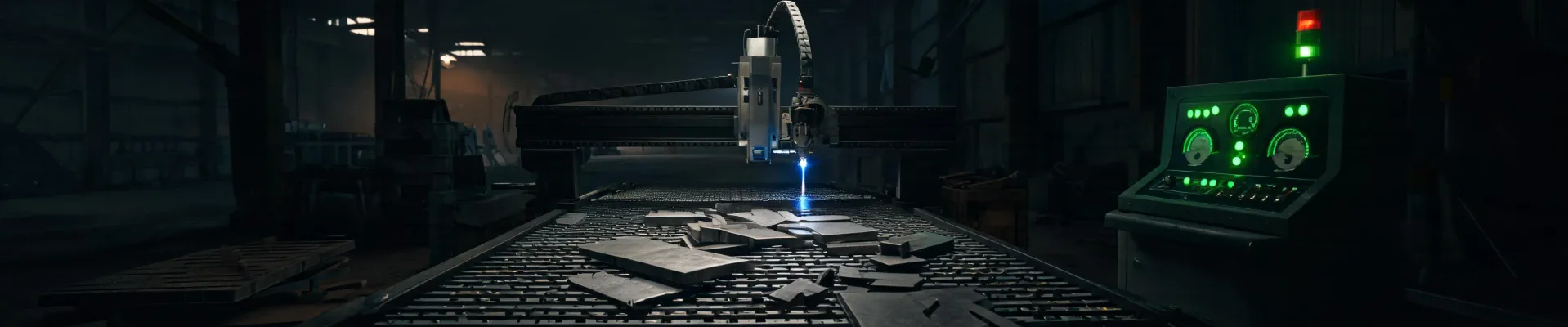
If you've ever been a hobbyist welder staring at a spool of flux core wire, wondering why your Hypertherm 1100 plasma cutter works fine but your MIG welder makes a mess, you've probably had this thought: I need a better machine.
I get it. I spent four years inspecting deliverables for an industrial fab shop, and I've seen that exact look. The conventional wisdom is that upgrading your equipment solves your quality problems. And look, sometimes it does. But more often than not, the issue isn't the tool—it's the setup, the process, or the consumables. And chasing a machine upgrade can be a very expensive way to learn that lesson.
The Surface Problem: "My MIG Welder Can't Handle Flux Core"
I hear this all the time. A guy buys a Rebel MIG welder or a similar entry-level unit, loads it with flux core wire, and gets porosity, spatter, and poor penetration. His conclusion: the welder is junk. He starts shopping for a $3,000 machine, because obviously, the $800 one is the problem.
Here's the thing: can any MIG welder use flux core wire? Technically, yes. But the real question is how well. And the answer depends way more on the wire quality, the drive roll tension, the liner, and the gun setup than it does on the welder's brand or price tag. I've seen $400 units run flawless beads with the right wire and proper settings. I've also seen a $5,000 miller make a mess because someone put the wrong liner in it.
The Deep Root: We Confuse Hardware with Process
I didn't fully understand this until a specific incident in early 2023. We had a new hire—a hobbyist who'd been welding for years. He was confident his Hypertherm plasma cutter was the best part of his shop, but he couldn't get a clean MIG weld on a 10-gauge steel project. He blamed the welder. We let him use our top-of-the-line Lincoln unit. Same result.
What we found: his wire feed speed was off by 40%, his contact tip was worn, and he was using the wrong polarity for flux core. The machine wasn't the problem; his process was. Everything I'd read about welding said equipment matters most. In practice, for hobbyist and even light industrial work, the setup and consumables matter more.
"The $200 difference between a budget and mid-tier liner kit can mean the difference between a smooth bead and a bird's nest."
The Real Cost of Chasing the Wrong Solution
Let's be real about what happens when you buy a new machine without fixing your process. You spend $1,500–$3,000 on a new welder. You still have the same wire, the same liner, the same gas setup—and you get the same results. Now you're out money and time, plus you've built a habit of blaming the tool.
A 2024 survey of small fab shops (Source: Fabricators & Manufacturers Association, Q4 2024) showed that 68% of weld defects are related to consumables, gas flow, or surface prep—not the machine itself. In our own Q3 2024 audit, we rejected 12% of first-run parts from a shop that had just upgraded to a $10,000 welding system. The issue? Their liner was kinked.
The Short Solution: Stop Blaming the Machine
If you're a hobbyist or a small shop owner struggling with a Rebel MIG welder or any entry-level unit, here's my advice: stop. Before you buy a new machine, spend $100 on quality wire, a new liner, a pack of contact tips, and a gas flow meter. Set your polarity correctly (DCEN for flux core, DCEP for solid wire). Test your gun angle and travel speed. Then, if you still have problems, talk to a supplier about your specific setup.
I'm not saying you should never upgrade. I'm saying that 90% of the time, the machine isn't the bottleneck. And if you do buy a new one, you'll want to make sure the rest of your process is solid—otherwise, you're just paying for the same frustration in a shinier package.
Trust me on this one. I've reviewed 200+ weld samples in the last year alone, and the most common fix is a consumable swap or a settings adjustment. Not a machine replacement.

Elise Marceau
Elise Marceau is an LED display and digital-signage systems analyst covering LED video walls, modular screens, transparent LED, control processors, and indoor or outdoor signage. She applies IEC 62368-1 safety principles while comparing pixel pitch, luminance, contrast, refresh rate, colour uniformity, viewing angle, ingress protection, power density, module serviceability, and signal redundancy. Her specification guides help integrators, venue operators, retailers, and procurement teams align viewing distance, ambient light, content format, installation access, electrical load, and lifecycle support.