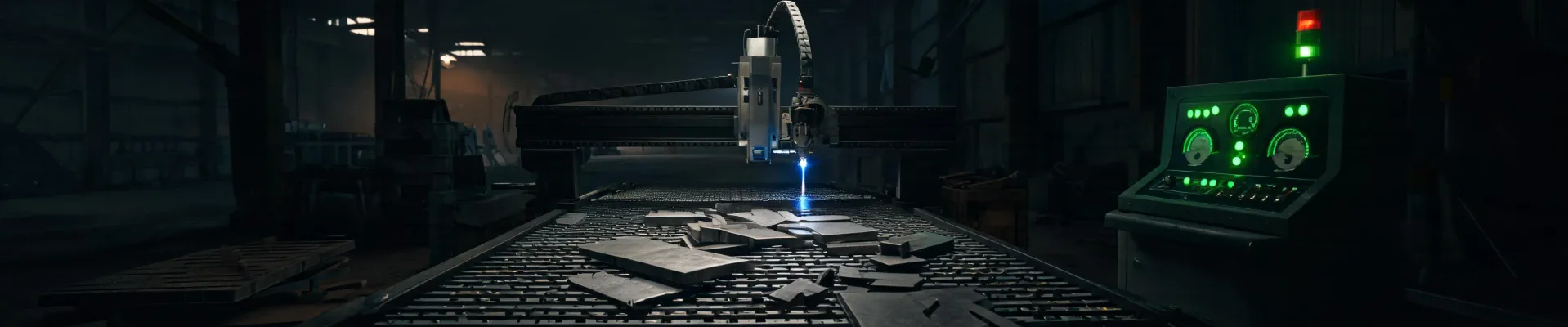
Last spring, I walked into the shop and found the Hypertherm table stopped. Not stopped for a tool change. Stopped in the middle of a half-cut plate, with the torch parked over the work like a question mark. Amber Chez, welder by trade and the person who knows our plasma table better than I do, was standing beside it with a flashlight. When she looked up, she said, “The cut edge is garbage.”
That phrase hits a cost controller differently than it hits an operator. I am responsible for the maintenance budget. When the plasma table goes down, everything else starts draining money: labor, overtime, scrap, missed deadlines, the whole chain.
Why I track total cost, not part price
I manage procurement for a 45-person steel fabrication company in Texas. We do structural steel, custom welded assemblies, and repair work for farmers and industrial plants. Our Hypertherm plasma system is not a decorative piece of equipment. It is the machine that feeds the MIG and TIG stations. If it stops, the welders eventually stop too.
For six years, I have kept a running cost file on our main equipment. It started as a simple spreadsheet, but it grew into a small monster. I track the original purchase price, the service visits, the consumable costs, the downtime hours, and the labor spent on each issue. I do that because I learned early that the cheapest invoice is not the same as the cheapest total cost.
That system failed me in February, when I bought a set of aftermarket consumables for the plasma torch.
The bargain that I should have questioned
The phone call went something like this. A supplier told me they carried a “compatible premium” kit for our torch. The kit included electrodes, nozzles, and swirl rings. It cost $248 for four sets. The genuine Hypertherm kit from our normal distributor was about $392 for the same number of sets. On paper, I saved $144.
The first couple of days were fine. Then the cuts changed. The bottom edge of half-inch plate started showing heavy dross, and the arc sounded rough at the start of each pierce.
I checked the obvious things. Air pressure was within range. The filter was new. The water level was fine. I adjusted the torch height and cut speed, and nothing helped. That is when Amber stopped me in the aisle and said we were burning through consumables too fast.
She bagged the used parts and brought them to my office. The electrode was pitted unevenly. The nozzle looked worn much earlier than it should have been. I still tried to defend the parts because the price difference made sense to me. Amber did not argue. She just said, “Call somebody who knows these machines before we lose another shift.”
Finding Hypertherm machinery maintenance in Texas
I found a service engineer who specializes in Hypertherm machinery maintenance in Texas. He came out on a Thursday morning, and I am glad he did.
He spent the first hour checking the machine itself. Air quality, gas pressure, torch height, cables, grounds. Then he asked for the receipt for the consumables. He looked at the supplier name and asked one question: “Are they an authorized distributor on the Hypertherm official website?” The answer was no.
I started explaining that I had compared dimensions and read reviews. He stopped me politely. He said he was not there to sell me the most expensive option. He was there to find out why a $144 purchase was costing us a full day of production.
What I found on the Hypertherm official website
After he left, I opened the Hypertherm official website and went to the support section. I probably spent ten minutes looking at the exploded diagrams and part numbers. Our normal distributor carried the right numbers. The aftermarket supplier did not list any official part number on the invoice.
That is when I had to admit the difference was not just the label. The cheap kits were shaped like the correct parts and screwed into the same torch, but the exact dimensions and materials were not verified by the machine manufacturer. For an office job, that might be fine. For a cutting table that runs every day, it is a gamble.
The actual cost of the lesson
Let me give you the final numbers, because those are the parts I remember.
The aftermarket kits saved me $144. The scrap that failed inspection cost about $2,100 in material and labor. The overtime needed to get another order back on schedule cost about $1,400. The service call cost $490. That is about $3,990 of damage caused by a $144 saving. The math was not on my side.
If I had not called the service engineer, the number would have been worse. I was about to authorize a new torch assembly before the engineer told me to wait. He said, “Let’s replace the consumables with the real parts first. If the problem goes away, we are done.” The problem went away.
I still kick myself for not doing that earlier. The machine was not broken. The torch was fine. The only thing wrong was my decision to buy components based on a photo and a price, rather than a verified source.
Advice for anyone researching Hypertherm parts and service
I am not here to say that every aftermarket consumable is terrible. I cannot say that with confidence, and our situation may be different from yours. If you run a light-duty shop and test a product in your own machine, maybe it works. But if you run production equipment, ask three questions before you order:
- Is the seller listed as an authorized distributor on the Hypertherm official website?
- Does the product number match the number in the machine manual or on the official parts diagram?
- If the part fails, will the seller help with the cost of downtime or only refund the part?
Question number three does more work than people expect. A refund on a $62 nozzle does not pay for a missed deadline. It does not pay your welders to stand around while you troubleshoot. It does not rebuild trust with your shop floor.
Maintenance in Texas is about the system, not the sticker
If you are searching for Hypertherm machinery maintenance in Texas, my advice is to find a technician who starts with questions. They should ask about your air supply, your duty cycle, your water cleanliness, and your cut speed. If they only want to quote a new torch assembly before checking the basics, find someone else.
The Hypertherm official website became part of my purchase process, but not because it is a magic source of knowledge. It helped me confirm which parts our machine requires and which suppliers are authorized to sell them. That step took ten minutes. It would have saved me thousands.
Amber now orders the plasma consumables, and I approve her requests without arguing over the line item. I learned that being the low-cost hunter on every purchase was making our total cost higher. There is a difference between being careful with a budget and being cheap at exactly the wrong moment.
The same rule has followed me outside the plasma table. When one of our field crews needs a gasoline MIG welder for a remote job, I ask about the engine, the duty cycle, and the wire type before I compare prices. When we quoted a spot welding machine dental labs use for a specialty repair customer, I spent more time on the exact application than on the discount. The precise machine matters. The precise use case matters. And the source matters more than the sticker price.

Elise Marceau
Elise Marceau is an LED display and digital-signage systems analyst covering LED video walls, modular screens, transparent LED, control processors, and indoor or outdoor signage. She applies IEC 62368-1 safety principles while comparing pixel pitch, luminance, contrast, refresh rate, colour uniformity, viewing angle, ingress protection, power density, module serviceability, and signal redundancy. Her specification guides help integrators, venue operators, retailers, and procurement teams align viewing distance, ambient light, content format, installation access, electrical load, and lifecycle support.