-
The expensive assumption that changed how I buy
-
Put your invoices into three piles first
-
Scenario A: cutting dominates. Buy the plasma cutter before the new welder
-
Scenario B: long heavy circular seams dominate. Positioning beats raw welding power
-
Scenario C: precision pipe runs dominate. Look at a high-quality orbital welding machine
-
How to tell which pile you actually live in
I bought the wrong machine twice before I understood the pattern. Twice. Each mistake cost the shop more than the machine's purchase price once rework and downtime were counted.
I've been handling equipment orders for a custom fabrication shop for eight years. I've personally made, and documented, eleven significant buying mistakes totaling roughly $47,000 in wasted budget. That number is not a badge of honor. It's why our team now has a pre-purchase checklist, and this article is that checklist in essay form.
If you're searching for plasma cutters Hypertherm, or trying to decide whether a Hypertherm Powermax 105 plasma cutter is worth the money, you probably want a simple 'buy this one' answer. There isn't one. I learned that the expensive way.
The expensive assumption that changed how I buy
When I first started specifying equipment in 2017, I assumed the most powerful machine was the safest machine. It sounds logical. A bigger welder can always turn down, right?
Except it can't turn down well in every mode. We bought a heavy multi-process unit with more amperage than our jobs required. My welders avoided it for short work because setup consumed time, they kept using older machines, and the expensive new unit spent months as the world's costliest dust collector. The lesson was not 'buy smaller.' The lesson was: stop comparing machines before comparing workloads.
Put your invoices into three piles first
Take one month of completed jobs. Ignore brand names. Sort the work by what actually caused effort:
- Pile 1: plate cutting plus structural fitting and welding. Base plates, brackets, frames, gates, repairs. The quality of the cut edge controls how fast the weld step goes.
- Pile 2: long heavy seams on cylindrical parts. Tank shells, pipe spools, pressure vessels, anything with a round seam that forces a welder into awkward positions.
- Pile 3: thin-wall tube and pipe with quality requirements. Stainless sanitary lines, dairy and food processing pipe, hydraulic tubing. Failures show up as leaks, rejections, or documentation problems.
Most shops have one pile that dominates. If you genuinely can't tell which one, rent instead of buy until you can.
Scenario A: cutting dominates. Buy the plasma cutter before the new welder
This was our shop in 2018. I spent a full quarter comparing welding machines while our real bottleneck was edge quality. Our old air plasma left a drossy edge with a measurable bevel on 16 mm plate. Every joint required grinding before welding, and the welders blamed the fit-up. They were right.
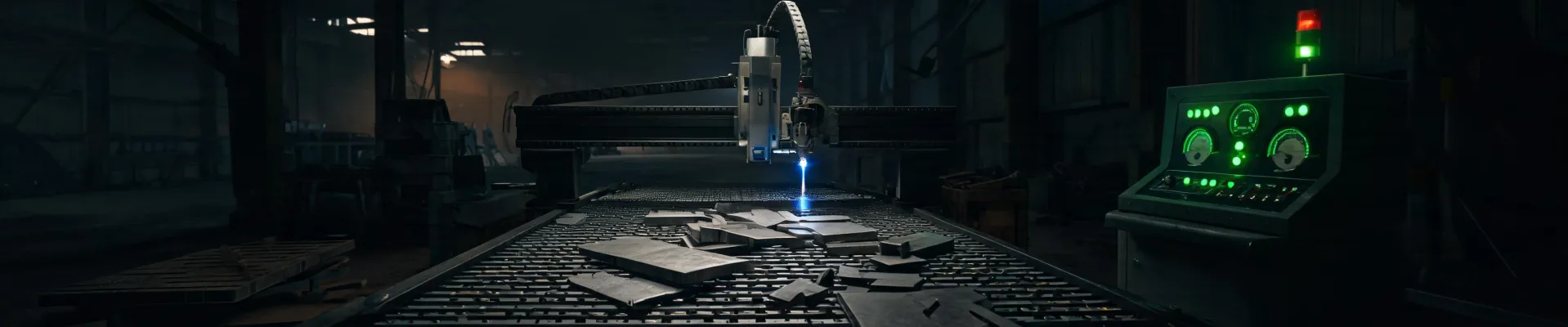
We replaced the cutting side with a Hypertherm Powermax 105 plasma cutter, and the change was immediate. According to Hypertherm's published product spec (hypertherm.com, checked January 2025), the Powermax 105 is a 105 A system with a 25 mm recommended cut capacity in mild steel and a 32 mm severance capacity. Verify that on the current product page, because models get revised. The number that mattered more to us was consistency. Our fitter stopped re-cutting parts, and the welders stopped complaining about gaps they didn't create.
A plasma cutter doesn't make you weld better. It makes your fit-up better, and better fit-up makes average welders look good.
One honest warning: if your plate is mostly under 6 mm, don't buy a 105 just because this article mentions it. A smaller Hypertherm unit will do the same job for less money and less air consumption. Buy the cutting capacity your actual pile of work demands.
Scenario B: long heavy circular seams dominate. Positioning beats raw welding power
The September 2022 disaster belongs in this pile. We took a tank order with long circumferential seams on 10 mm shells. The knee-jerk reaction from everyone, including me, was to buy a bigger welder. We did. Weld quality improved slightly, but our reject rate stayed high because the welder still had to reach seams in vertical and overhead positions.
Our breakthrough came from a piece of equipment I initially dismissed: a 10-tonne welding turning rolls set. The model from our regular supplier is the JH-10T welding equipment. It rotates the tank shell at a controlled speed so the weld stays in the flat or downhill position. Gravity starts working for the welder instead of against him.
If your work matches Pile 2, the purchase order should be: positioning first, then a heavy welding machine. Not the other way around. A 500 A machine welding an overhead seam still produces an overhead weld. A modest machine with the workpiece rotating at the right speed produces a better weld, with less fatigue, in a fraction of the time.
That was the counter-intuitive lesson for me. I used to think every heavy welding problem needed more amperage. After watching a turning rolls set cut our rework in half, I'd rather have a mid-size machine plus rotation than a monster machine with no way to position the work.
Scenario C: precision pipe runs dominate. Look at a high-quality orbital welding machine
Honestly, I used to think orbital welding was reserved for pharmaceutical cleanrooms and nuclear code shops. That assumption cost us time.
In Q1 2024, we hit our third rejection in three weeks on a stainless sanitary line. The manual TIG welds looked acceptable to the naked eye, but the customer wanted repeatable weld data and cleaner roots than our hand work could deliver consistently. We finally bought a high-quality orbital welding machine, and it did not replace our best welder. It replaced the repetitive job he hated most.
What nobody told us: an orbital machine will not fix bad preparation. It makes bad preparation obvious. We lost three days learning that the bevel angle, the cut squareness, and the internal purge all matter more than the weld program. Once we fixed those, the machine made every pass look like the last one.
If you're weighing this option, budget for training time and better tube prep tooling. The machine is only part of the system.
How to tell which pile you actually live in
Don't trust your memory. Trust your invoices. Ask yourself:
- Which job produced the most grinding and rework last month? If the problem started at the cut edge, you're in Scenario A.
- Which job produced rejections on seams that were hard to reach? If your welders were fighting positions instead of parameters, you're in Scenario B.
- Which job generated leak failures or documentation requests on small-diameter pipe? You're in Scenario C.
If one pile represents less than about 60 per cent of your hours, do not buy an expensive compromise machine to cover all three. Buy a good small plasma cutter first, and rent the specialist equipment for Pile 2 or Pile 3 jobs until the pattern becomes clear. Rental invoices hurt less than another unused machine.
One more honest note: equipment specs change. The plasma cutters Hypertherm sells today are not identical to the ones I bought. Prices vary by region and distributor, so I don't quote them here; an outdated number is worse than no number. Verify current models, consumables, and duty cycle ratings at hypertherm.com or with your local distributor before you sign.
If you take one thing from my mistakes: don't buy capability you might use someday. Buy the capability that solves the pile of work that already exists. That's where the money is. I learned it after $47,000 of mistakes. Yours can be cheaper.

Elise Marceau
Elise Marceau is an LED display and digital-signage systems analyst covering LED video walls, modular screens, transparent LED, control processors, and indoor or outdoor signage. She applies IEC 62368-1 safety principles while comparing pixel pitch, luminance, contrast, refresh rate, colour uniformity, viewing angle, ingress protection, power density, module serviceability, and signal redundancy. Her specification guides help integrators, venue operators, retailers, and procurement teams align viewing distance, ambient light, content format, installation access, electrical load, and lifecycle support.