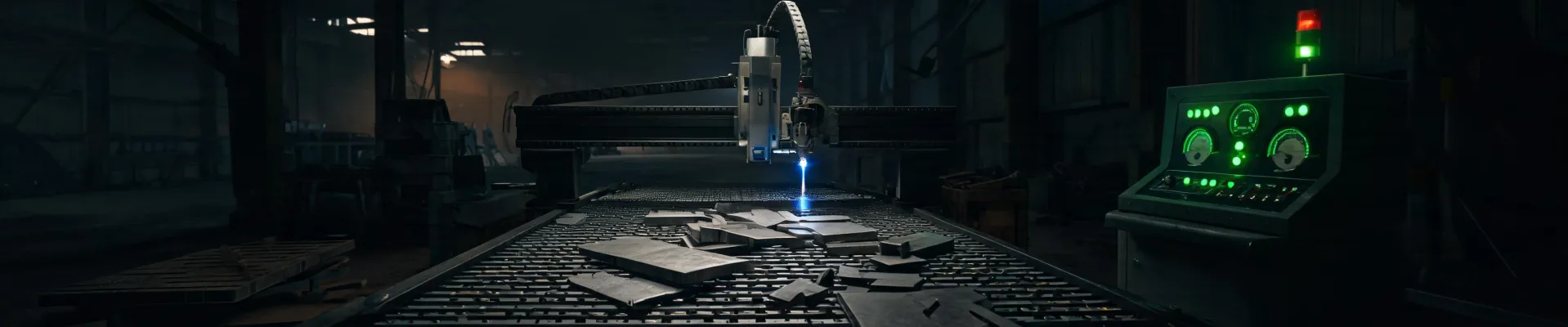
There is no single "best" cutting or welding setup, and the sooner a shop accepts that, the less money it wastes. A plasma cutting system cuts conductive metal plate; it doesn't join parts. A MIG TIG inverter welder joins parts; it doesn't cut plate. A machine laser welding setup also joins parts—only faster on thin, clean, well-fitted joints. They overlap less than the marketing suggests.
Since 2020 I've handled purchasing for a metal fabrication shop of about 35 people. That has meant ordering Hypertherm plasma cutting systems, buying Hypertherm plasma cutter torch consumables, choosing inverter welders, and testing laser welding equipment. The clearest lesson I've learned is to stop asking "Which machine is best?" and start asking "What situation am I buying for?"
Three situations cover most small and mid-size metal shops:
- Repair and maintenance work—every job is different: trailers, gates, farm equipment, broken brackets, random stainless patches.
- Production fabrication—the same cuts and welds repeat in batches, and turnaround time is part of your quote.
- Thin, appearance-critical work—handrails, furniture, kitchen equipment, architectural stainless and aluminum where heat distortion and weld cosmetics matter.
The recommendations below are starting points, not product rankings. Your exact material thickness, operator skill, and available space change the details.
Scenario 1: Repair and maintenance work
If your shop does mostly repair jobs, you don't control the material. One morning it's 3 mm aluminum, the next afternoon it's rusty 12 mm plate, and the joint often doesn't fit the way it should. You need flexibility more than raw speed.
A practical starting package
- A compact Hypertherm plasma cutter torch setup in the Powermax 45 XP class. A 45-amp air plasma system is the sweet spot for a repair shop. It cuts carbon steel, stainless, and aluminum, and it can gouge when you need to remove a bad weld. It doesn't need a big three-phase supply, and it's easy to move around the shop.
- A 200-amp-class MIG TIG inverter welder with stick capability. One inverter machine can cover MIG for structural steel, TIG for thinner stainless, and stick for outdoor or dirty work. If you are just getting started, this gives you more room to find your actual work mix.
What about machine laser welding? In a repair environment, don't buy it yet. That sounds conservative, but a handheld laser welding machine is not a great fit for rust, mill scale, painted edges, and poorly fitting joints. It's fantastic when the edges are clean and the gap is controlled. In a break/fix shop, those conditions are rare. A plasma cutter plus a MIG TIG inverter welder will fix most of what comes through the door.
Scenario 2: Production fabrication and repeat work
If you fabricate the same frames, brackets, carts, or structural assemblies in batches, the buying logic changes. Speed and uptime matter more than the ability to switch processes. This is where I've seen shops make a costly mistake: they buy one all-in-one multi-process machine to save floor space, then spend too much time switching from MIG to TIG and back again.
Multiple welding machine setups often make more sense
In a production bay, changing process setup is expensive. Every time an operator switches from MIG to TIG, they change liner, drive rolls, gas, torch, and settings. If that happens twice a day, you're losing real production time. Dedicated stations—one pulse MIG for steel, one AC/DC TIG for aluminum, or two MIG machines running the same job—usually pay for themselves in throughput.
That same logic applies to cutting. If you have a CNC plasma table cutting plate all day, the plasma system should be matched to the table and the material, not chosen just because it's a familiar model name. This is where the exact ordering details matter.
Ordering detail: the Hypertherm plasma cutting system shipping code
When a quote says "Hypertherm plasma cutting system," ask for the full product code. The Hypertherm plasma cutting system shipping code on the quote tells you which torch is in the crate, what cable length is included, and whether it's set up for hand cutting or machine/CNC use. Those details change the price more than you'd think.
Our shop once compared two quotes for what looked like the same plasma system. One was a hand-torch package; the other was a machine-torch package for table use. The price difference was hundreds of dollars, and the parts are not interchangeable. Always confirm the shipping code, torch type, cable length, and whether consumables are included before you place the order. The serial number on the crate should match the packing list when it arrives.
Where laser welding fits in production
Machine laser welding can earn its space in a production shop if you have long, clean, repetitive seams on thin stainless or aluminum. On the right job, it's faster than TIG and puts less heat into the part. But it won't fix poor fit-up, and it won't replace a MIG on thicker carbon steel. Test it on your actual jobs, not on a clean sample made by the salesperson.
Scenario 3: Thin stainless, aluminum, and appearance-critical work
If your shop builds handrails, custom furniture, food equipment, or architectural metal, the material is usually 3 mm or thinner, and the customer notices heat distortion. TIG has been the standard for this work for good reasons, but it's slow. This is the scenario where laser welding becomes genuinely attractive.
The case for adding machine laser welding
On a clean, well-fitted seam in 1.5 mm stainless, laser welding is noticeably faster than TIG and produces far less distortion. For repetitive decorative parts, it can cut labor time dramatically. It also reduces the amount of grinding and polishing afterward—that's where the real cost often hides.
That said, a laser welder is not a TIG replacement. It needs proper eye protection, fume extraction, and operator training. It also needs a joint that's been prepared consistently. If your work is one-off art pieces with irregular joints, keep the TIG machine and skip the laser until the work repeats enough to justify it.
You still need a way to cut components. For visible thin stainless, plasma is not always the best first choice because the heat-affected edge can require cleanup. Many shops in this category cut blanks on a fiber laser, waterjet, or shear—or send large cutting jobs out. A small Hypertherm plasma cutter torch is still useful for brackets, fixtures, and the parts nobody sees.
Which scenario are you in?
Answer these questions using the jobs you've actually run in the last few months, not the work you hope to attract next year:
- Is most of your work thicker than 3 mm carbon steel? Start with Scenario 1 or 2, not laser welding.
- Do more than half of your jobs repeat in batches? Start with Scenario 2's production layout: dedicated weld stations and a plasma system matched to your table.
- Is most of your work thin stainless or aluminum with visible welds? Start with Scenario 3, and build your buying plan around heat control and cosmetics.
If your budget is tight, use a simple order of operations: plasma cutter first when you cut plate regularly, then the welder that handles your most common joint, and only then consider a laser. The plasma system is the tool that prepares the metal for every process after it.
When one vendor quotes a "system" and another quotes a "system," open the spec sheets. The cut charts, duty cycles, and included torch packages tell the real story—and the shipping code on the quote tells you what you're actually paying for.
Buy for the jobs that pay the rent. The demo video for the newest machine will always look better than the reality of cutting rusty plate at 8 a.m. on a Tuesday.

Elise Marceau
Elise Marceau is an LED display and digital-signage systems analyst covering LED video walls, modular screens, transparent LED, control processors, and indoor or outdoor signage. She applies IEC 62368-1 safety principles while comparing pixel pitch, luminance, contrast, refresh rate, colour uniformity, viewing angle, ingress protection, power density, module serviceability, and signal redundancy. Her specification guides help integrators, venue operators, retailers, and procurement teams align viewing distance, ambient light, content format, installation access, electrical load, and lifecycle support.