-
This Article Started With a Confusing Purchase Request
-
The Oldest Machine on Our Floor Taught Me Not To Chase Shiny Things
-
The Comparison Framework I Used
-
Dimension 1: The Bottleneck Test
-
Dimension 2: Sticker Price vs. Total Cost
-
Dimension 3: Will It Be Done When the Customer Needs It?
-
What I Approved, and What I'd Still Buy
This Article Started With a Confusing Purchase Request
In early 2024, two of our technicians asked me to approve a small air cooled laser welding machine. The demo was impressive on thin stainless steel. Clean weld. Less heat. Less grinding. I almost said yes right there. Then I asked what job had triggered the request. The answer was not 'we need to weld more stainless.' The answer was that fabricated plate parts were late because we could not cut them fast enough. The request was a solution looking for a problem.
I'm a procurement manager at a 45-person industrial repair company. For the last six years, I've managed a roughly $180,000 per year equipment and MRO budget. That background makes me suspicious of demos and careful about total cost. I don't want the most advanced tool in the catalog. I want the tool that makes the next customer deadline look easy.
The Oldest Machine on Our Floor Taught Me Not To Chase Shiny Things
We still have the oldest welding machine in our shop on the floor. It's an old AC/DC stick welder that can run a 1/8-inch electrode all day. Is it efficient? No. Is it reliable? Completely. I've kept it alive because simple carbon-steel repairs do not require a $10,000 upgrade. Old isn't automatically bad.
That lesson works both ways. In 2023, I initially rejected a request for a CIPP welding machine. It seemed too narrow. CIPP liner repair is a niche service, and I didn't want a single-purpose machine. I lost that argument, and then I was wrong. That CIPP welding machine paid for itself in seven months because the liner repair work was recurring. It did one job, but it did that one job repeatedly and profitably.
So when the small air cooled laser welding machine request appeared, I could not call it 'niche' and move on. I had to apply the same test I use for any serious equipment purchase.
The Comparison Framework I Used
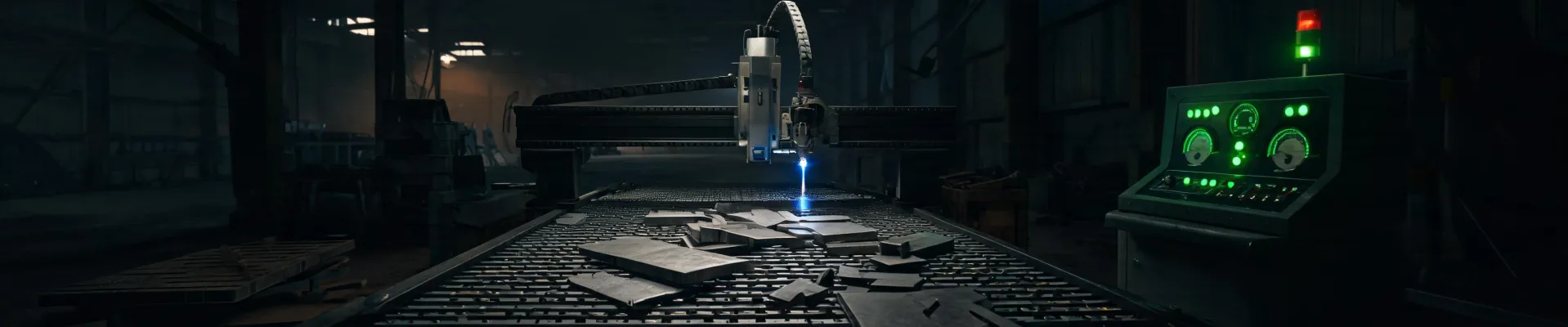
I compared the small air cooled laser welding machine with a Hypertherm Powermax30 XP plasma cutter. Yes, that looks unfair. One is a welder, the other is a cutter. But in our budget review, they were both competing for the same capital line. The plasma cutter was the alternative that solved the bottleneck. The laser was the alternative that solved a smaller, more glamorous bottleneck.
I used three dimensions: Does it remove the bottleneck? What does the three-year total cost look like? Can it make a deadline when the deadline is real?
Dimension 1: The Bottleneck Test
The parts that were late were steel plate parts: 1/4-inch and 3/8-inch brackets, base plates, and adapters. We had been sending them to an outside laser cutting shop, and their lead times kept slipping. On the floor, the old welders were waiting for parts. That waiting time was the real problem.
In the demo, the small air cooled laser welding machine excelled on 1.5 mm stainless tube. It made beautiful welds on thin material. But when the sales rep tried to show it as a cutting machine on thicker plate, the machine slowed down and left dross. I'm not a laser engineer, and I won't pretend to understand every beam mode. What I understand is a timer. The parts we were late on required a plasma-style cut.
The Hypertherm Powermax30 XP plasma cutter was more useful on our actual queue. It handled the 3/8-inch plate work we had without slowing down. Yes, it's a 30-amp machine, not a heavy-plate monster. That's actually my point: it's the size that matches the bottleneck.
Dimension 2: Sticker Price vs. Total Cost
The supplier of the small air cooled laser welding machine quoted a price that looked like an easy yes. It was lower than I expected. Then I thought about shielding gas, training, spare optics, and the risk of a machine sourced from a vendor whose support I couldn't test. I'm not saying those costs apply to every small air cooled laser welding machine. I'm saying they apply to the one we were considering.
The Hypertherm Powermax30 XP had a higher initial quote. Not dramatically higher, but higher. What sold me was the cost after the purchase. Consumables were easy to confirm. Our local distributor stocked the parts that wear out. Our technicians could use it without a two-week certification course. And the support structure felt like an investment, not a gamble.
The question came up: why not buy an even bigger Hypertherm Powermax 125? I checked the Hypertherm Powermax 125 price and felt the pull. More power. Faster cuts. But our records showed only about 10 percent of cut jobs would need more than the 30-amp class. Paying the Powermax 125 capital cost for a 10 percent use case is exactly the mistake I try to avoid. If our work changes and heavy plate becomes regular, buying a 125 later will be easy to justify. Today it wouldn't be.
Dimension 3: Will It Be Done When the Customer Needs It?
The outside cutting vendor kept saying 'should be done by Friday.' Twice, Friday came and nothing arrived. The real cost of that miss was not just the invoice. It was having a crew stand around and a customer deadline at risk.
A less reliable tool is never cheaper. We paid $430 in March 2024 to expedite a replacement component for a critical job. On its own, that payment looked wasteful. Compared with the $12,000 service contract we would have missed, it was a bargain.
One line in the laser brochure said the machine could 'replace your plasma cutter.' That is a strong performance claim. Per FTC advertising guidelines (ftc.gov/business-guidance/advertising-marketing), claims like that need substantiation. I asked for a timed test on 3/8-inch plate. The test didn't match the claim.
The small air cooled laser welding machine might have been fine after a few months of setup and testing. But 'maybe' is not a schedule. The Hypertherm distributor gave us a firm lead time, had support locally, and agreed to provide cut samples using our actual material before we ordered. That is the kind of certainty I need.
A cheaper plan that isn't certain is more expensive than a certainty that costs a little more.
What I Approved, and What I'd Still Buy
We approved the Hypertherm Powermax30 XP plasma cutter. One week after installation, a customer asked for 12 mild-steel brackets by Thursday. The old way would have meant waiting for an outside cutting vendor. That week, the oldest welding machine in our building did the welding, the Powermax30 XP did the cutting, and the job shipped Wednesday. No drama. No missed deadline.
Would I still consider a small air cooled laser welding machine? Yes. If your main operation is stainless handrails, thin-wall tubing, or sheet-metal weldments, and your cutting capacity is already handled, a small air cooled laser welding machine can be a great production tool. Low heat input and clean cosmetic welds matter in those shops. This decision is not about laser technology being bad. It's about matching the machine to the job that is losing money.
The CIPP welding machine is still earning its keep. The oldest welding machine in our shop is still running. The Powermax30 XP didn't replace any of them. It replaced the wait.

Elise Marceau
Elise Marceau is an LED display and digital-signage systems analyst covering LED video walls, modular screens, transparent LED, control processors, and indoor or outdoor signage. She applies IEC 62368-1 safety principles while comparing pixel pitch, luminance, contrast, refresh rate, colour uniformity, viewing angle, ingress protection, power density, module serviceability, and signal redundancy. Her specification guides help integrators, venue operators, retailers, and procurement teams align viewing distance, ambient light, content format, installation access, electrical load, and lifecycle support.