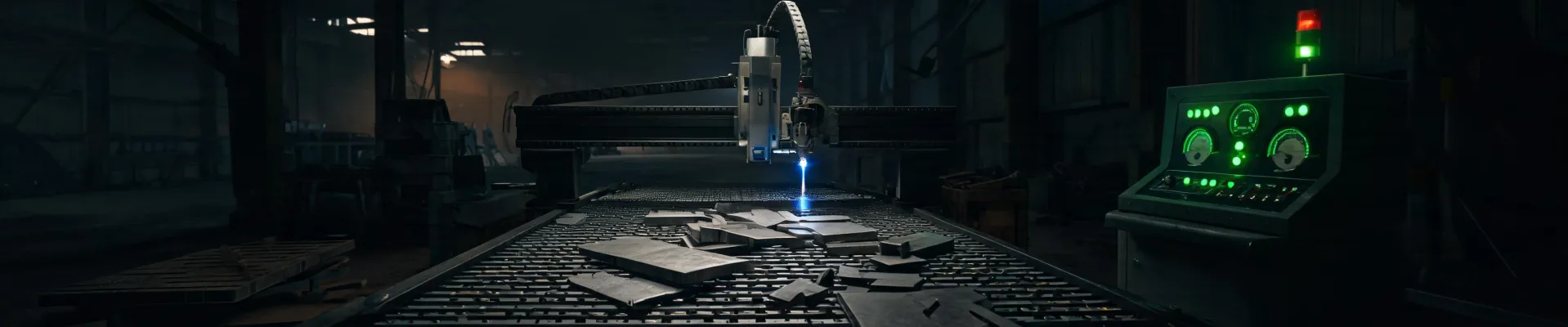
- Scenario 1: The Edmonton Fabrication Shop and the Hypertherm Powermax 800 Plasma Cutter Question
-
Scenario 2: If You Need an ERW Welding Machine, You're Buying a Production System
-
Scenario 3: Code-Critical Piping and What 'Orbitalum Welding Machine Price' Really Means
-
How to Tell Which Scenario You're Actually In
I'm the quality/compliance manager at an industrial cutting and welding equipment supplier in western Canada. I review over 200 machine configurations a year before they go into a quote or into our rental fleet. In Q4 2024 alone, I rejected about 18% of first deliveries — not because the equipment wouldn't run, but because what arrived didn't match the application spec we'd agreed on.
If you've been typing 'welding machine Edmonton' into a search bar, you're probably expecting a brand comparison. Here's the awkward truth from my side of the table: the brand is not the first decision. The first decision is what kind of work actually repeats in your shop. A machine that's excellent for one business can be the wrong technology for the shop two blocks away.
Start by sorting yourself into one of three situations:
- Scenario 1 – General fab and repair. You cut plate or pipe to size, fit it up, and weld it. A lot of your weld quality is decided before the arc starts — by the cut edge.
- Scenario 2 – Pipe and tube production. You're not welding individual parts. You're forming coil into a round shape and making a continuous seam as material moves through the line. That's an ERW welding machine application.
- Scenario 3 – Code-critical piping. Your welds have to pass X-ray, pressure tests, or traceability audits. That's where orbital welding equipment — and the real cost of an Orbitalum-class machine — enters the conversation.
Scenario 1: The Edmonton Fabrication Shop and the Hypertherm Powermax 800 Plasma Cutter Question
Most general fabrication shops I deal with in the Edmonton area — Nisku, Acheson, Leduc — spend as much time cutting as they do welding. Think about it: every bracket, every repair, every custom piece starts with cutting plate, coping tube, or removing old welds. If the cut edge is ragged, weld prep is ragged. The plasma cutter sets up the weld joint before the welder ever touches it.
This is the scenario where Hypertherm's reputation makes sense. These are machines built for daily production use, and their consumable design has influenced the whole industry. But here's where I'd gently push back on the idea that an older used unit is automatically the smart buy.
Should You Buy the Hypertherm Powermax 800 Plasma Cutter Used?
You still see the Hypertherm Powermax 800 plasma cutter in used listings around western Canada. It was a serious machine in its day, and plenty of them are still running. But by January 2025, you're not buying current technology. You're buying someone else's maintenance history.
Before you hand over cash for an 800, do two things. First, check parts and consumable availability with the serial number. I'm not going to pretend I know the exact support status for every serial range — call Hypertherm's service line directly. Second, inspect the torch lead carefully. A stiff, cut, or repaired lead is not a cheap fix. A used machine priced at a bargain stops being a bargain the moment you're waiting a week for a torch assembly.
What About the Hypertherm 1100 Plasma Cutter?
The phrase 'Hypertherm 1100 plasma cutter' usually means the Powermax 1100, another veteran of the Hypertherm lineup. These units show up frequently in auctions and shop closings, and I honestly understand the appeal. For a small fab shop or a maintenance crew just moving into plasma cutting, a running Powermax 1100 can be a decent first cutter.
But here's where I see buyers make the same mistake repeatedly: they compare the used price against the new price of a much smaller machine. That's not apples to apples. An old professional-duty unit can outperform a new entry-level unit, but only if it can actually run next week. Ask for a demo on your own material. If the seller won't demo it, walk away.
From a total cost perspective, the machine price is the smallest part of the equation. Consumables, cutting speed, downtime, and edge quality all show up on the shop floor every day. A $700 saving on the purchase price evaporates quickly when you lose two afternoons to downtime or spend an extra 20 minutes grinding every edge before welding.
Scenario 2: If You Need an ERW Welding Machine, You're Buying a Production System
When someone searches for 'ERW welding machine,' they usually aren't a welder looking for a new power source. They're a manufacturer who wants to make welded pipe or tube. ERW stands for Electric Resistance Welding. Instead of filler metal, the two edges of the formed tube are heated by high-frequency current and forged together under pressure. It's fast, efficient, and completely different from the fabrication world above.
The trap is thinking of an ERW welding machine as a single box. It isn't. In practice, an ERW line includes coil handling, a forming section, the high-frequency welder, seam scarfing, sizing, cooling, and a cut-off system. The welding station is important, but it's one part of a much longer chain. If the strip edges aren't aligned as they enter the welding point, no amount of welding power will fix a persistent seam defect.
Some of the worst quality problems I've audited in welded pipe had nothing to do with the welding power source. They traced back to roll tooling alignment, inconsistent strip width, or cooling issues. That's why I always tell buyers to look beyond the machine supplier's brochure.
I learned this the hard way early in my career. We didn't have a formal acceptance process for a line we were taking delivery on, and it cost us a re-commissioning visit that nobody had budgeted for. Now we write the acceptance criteria into the quote before payment: a test run on the customer's material, at the promised line speed, with samples checked against the relevant product standard. If a supplier resists that clause, that tells you something.
If you're making ERW pipe for the energy or construction market, the standards matter. Ask which standard your product must meet — API 5L, ASTM A53, ASTM A500, or similar — and ask how the supplier verifies the seam. A machine price means nothing if the first production run doesn't pass the required flattening, flaring, or hydrostatic tests. I'm not a metallurgist, so I won't pretend to lecture anyone on grain structure. But from a quality perspective, the test records are the product. If the supplier can't show you a clear testing plan, keep looking.
Scenario 3: Code-Critical Piping and What 'Orbitalum Welding Machine Price' Really Means
Now the third scenario, and the one where 'welding machine price' can mislead you the most. If you fabricate stainless or alloy piping for food processing, dairy, pharmaceuticals, or gas systems, your welds need consistency and traceability. Hand TIG welding depends on the welder's skill, fatigue level, and the hour of the shift. Orbital welding automates the rotation of the torch around the pipe joint, which removes a huge amount of human variation.
Orbitalum is one of the established names in this field, along with a few others. When someone searches for 'orbitalum welding machine price,' they usually want a single number. Here's my honest answer as of January 2025: there is no meaningful single number, because the total price depends on which welding heads are included. A head for 1-inch tubing is different from a head for 6-inch pipe, and most shops need several sizes.
What I can tell you is to budget at a different level than you would for a manual TIG machine. If you're comparing an orbital package against a $3,000 hand TIG setup, you're comparing two different businesses. The orbital machine is a capital investment in repeatability and documentation. Many complete packages land in five-figure territory once you add heads, cables, and data recording. Don't hold me to that, because options vary widely — but it's a realistic starting point for planning.
Is it worth it? That depends on what a rejected weld costs you. In code-critical piping, a failed weld often means cutting the joint out, re-welding, re-inspecting, and potentially delaying an entire skid or shutdown. One bad field joint can easily cost more than the price difference between a high-end manual setup and a basic orbital package. From a quality standpoint, you're not buying a machine. You're buying fewer surprises.
How to Tell Which Scenario You're Actually In
If you're not sure which category fits your shop, don't start with equipment prices. Start with three questions:
- What does your revenue repeat on? If you build custom parts and repairs, that's scenario one. If you sell welded pipe or tube by the tonne, that's scenario two. If your pipe joints require documented weld data for a client, that's scenario three.
- What does a rejected product cost you? A messy structural weld might cost you 20 minutes of grinding. A failed orbital weld in a food-grade line can cost you a shift, a re-test, and client trust. The higher the cost of failure, the more automation and quality control you should buy.
- Which standards are your customers buying to? If they mention API 5L, ASTM A53, or ASME B31.3, your equipment decision has to support those requirements. A cheap machine that can't produce repeatable, documented results isn't cheap at all.
Here's the best first step before any purchase: ask for a trial on your own material. For plasma cutting, bring in the plate you actually cut every week and compare edge quality and speed. For an ERW line, ask for a test run at full production speed with samples pulled in front of you. For orbital welding, run your actual tube spec and review the weld data afterwards.
There's no single 'best' welding machine in Edmonton. But there is a right answer for the work your shop actually does. A used Hypertherm Powermax 800 or 1100 can be a smart move for a fabricator. An ERW line is a completely different decision. And an Orbitalum-class orbital package makes sense when the weld record matters as much as the weld itself. Match the machine to the repeated job — not to the listing price.

Elise Marceau
Elise Marceau is an LED display and digital-signage systems analyst covering LED video walls, modular screens, transparent LED, control processors, and indoor or outdoor signage. She applies IEC 62368-1 safety principles while comparing pixel pitch, luminance, contrast, refresh rate, colour uniformity, viewing angle, ingress protection, power density, module serviceability, and signal redundancy. Her specification guides help integrators, venue operators, retailers, and procurement teams align viewing distance, ambient light, content format, installation access, electrical load, and lifecycle support.